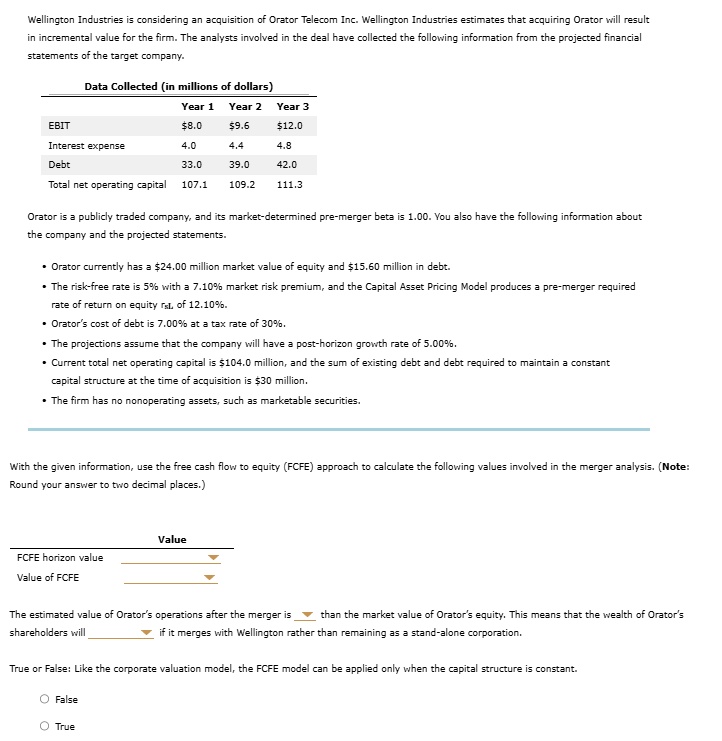
Wellington Industries is considering an acquisition of Orator Telecom Inc. Wellington Industries estimates that acquiring Orator will result
in incremental value for the firm. The analysts involved in the deal have collected the following information from the projected financial
statements of the target company.
Data Collected (in millions of dollars)
Year 1 Year 2 Year 3
EBIT $8.0 $9.6 $12.0
Interest expense 4.0 4.4 4.8
Debt 33.0 39.0 42.0
Total net operating capital 107.1 109.2 111.3
Orator is a publicly traded company, and its market-determined pre-merger beta is 1.00. You also have the following information about
the company and the projected statements.
• Orator currently has a $24.00 million market value of equity and $15.60 million in debt.
The risk-free rate is 5% with a 7.10% market risk premium, and the Capital Asset Pricing Model produces a pre-merger required
rate of return on equity rs, of 12.10%.
• Orator's cost of debt is 7.00% at a tax rate of 30%.
• The projections assume that the company will have a post-horizon growth rate of 5.00%.
Current total net operating capital is $104.0 million, and the sum of existing debt and debt required to maintain a constant
capital structure at the time of acquisition is $30 million.
• The firm has no nonoperating assets, such as marketable securities.
With the given information, use the free cash flow to equity (FCFE) approach to calculate the following values involved in the merger analysis. (Note:
Round your answer to two decimal places.)
Value
FCFE horizon value
Value of FCFE
The estimated value of Orator's operations after the merger is
shareholders will
than the market value of Orator's equity. This means that the wealth of Orator's
if it merges with Wellington rather than remaining as a stand-alone corporation.
True or False: Like the corporate valuation model, the FCFE model can be applied only when the capital structure is constant.
False
True