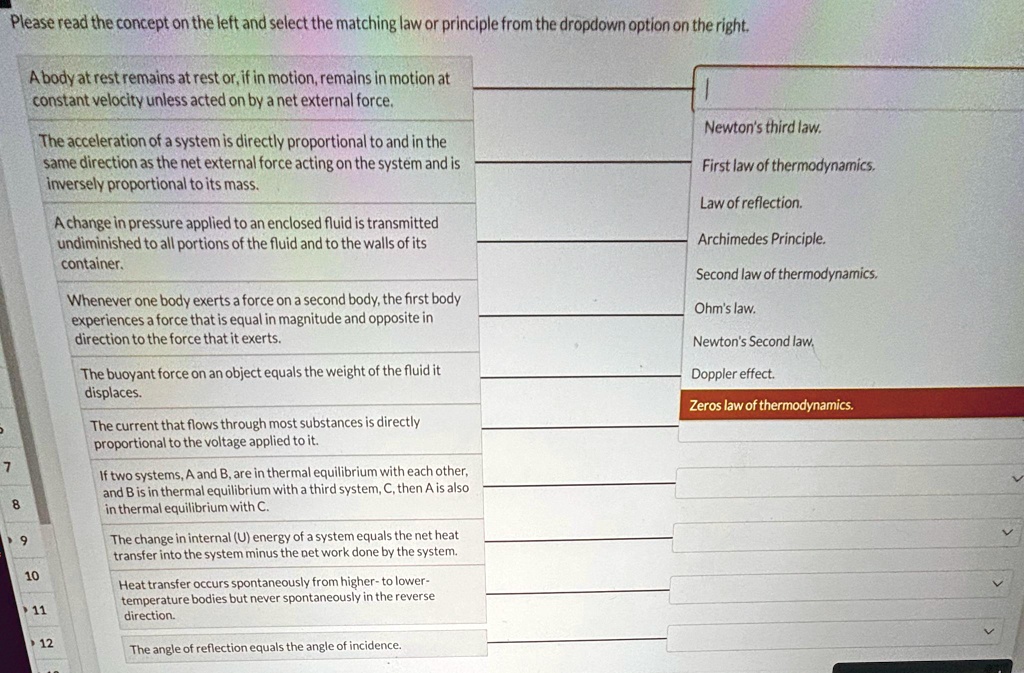
Please read the concept on the left and select the matching law or principle from the dropdown option on the right.
A body at rest remains at rest or, if in motion, remains in motion at
constant velocity unless acted on by a net external force.
The acceleration of a system is directly proportional to and in the
same direction as the net external force acting on the system and is
inversely proportional to its mass.
A change in pressure applied to an enclosed fluid is transmitted
undiminished to all portions of the fluid and to the walls of its
container.
Whenever one body exerts a force on a second body, the first body
experiences a force that is equal in magnitude and opposite in
direction to the force that it exerts.
The buoyant force on an object equals the weight of the fluid it
displaces.
The current that flows through most substances is directly
proportional to the voltage applied to it.
If two systems, A and B, are in thermal equilibrium with each other,
and B is in thermal equilibrium with a third system, C, then A is also
in thermal equilibrium with C.
The change in internal (U) energy of a system equals the net heat
transfer into the system minus the net work done by the system.
Heat transfer occurs spontaneously from higher- to lower-
temperature bodies but never spontaneously in the reverse
direction.
The angle of reflection equals the angle of incidence.
Newton's third law.
First law of thermodynamics.
Law of reflection.
Archimedes Principle.
Second law of thermodynamics.
Ohm's law.
Newton's Second law,
Doppler effect.
Zeros law of thermodynamics.