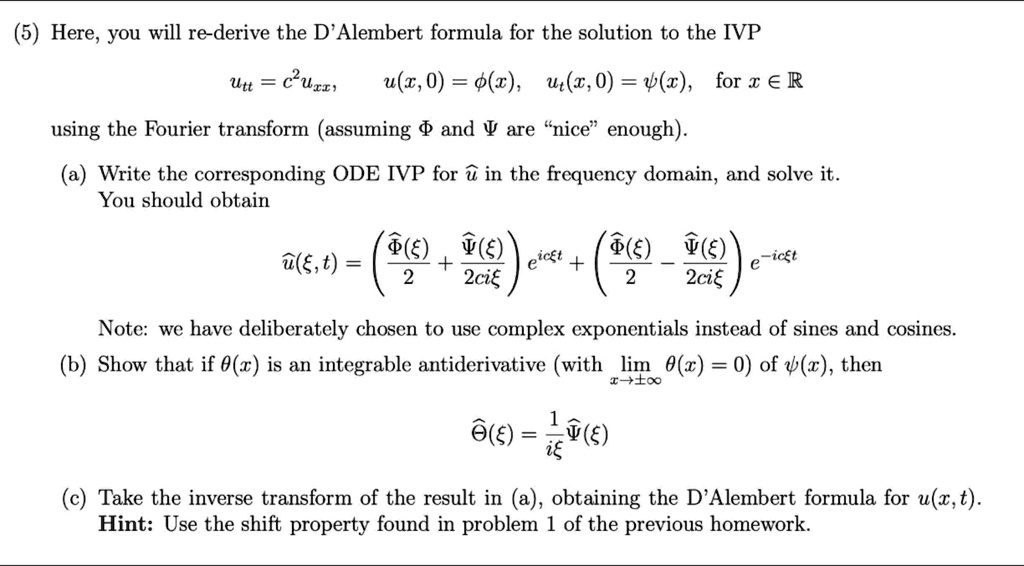
(5) Here, you will re-derive the D'Alembert formula for the solution to the IVP
$$u_{tt} = c^2 u_{xx}, \quad u(x, 0) = \phi(x), \quad u_t(x, 0) = \psi(x), \quad \text{for } x \in \mathbb{R}$$
using the Fourier transform (assuming $\Phi$ and $\Psi$ are "nice" enough).
(a) Write the corresponding ODE IVP for $\hat{u}$ in the frequency domain, and solve it.
You should obtain
$$\hat{u}(\xi, t) = \left( \frac{\hat{\Phi}(\xi)}{2} + \frac{\hat{\Psi}(\xi)}{2ci\xi} \right) e^{ic\xi t} + \left( \frac{\hat{\Phi}(\xi)}{2} - \frac{\hat{\Psi}(\xi)}{2ci\xi} \right) e^{-ic\xi t}$$
Note: we have deliberately chosen to use complex exponentials instead of sines and cosines.
(b) Show that if $\theta(x)$ is an integrable antiderivative (with $\lim_{x \to \pm \infty} \theta(x) = 0$) of $\psi(x)$, then
$$\hat{\Theta}(\xi) = \frac{1}{i\xi} \hat{\Psi}(\xi)$$
(c) Take the inverse transform of the result in (a), obtaining the D'Alembert formula for $u(x, t)$.
Hint: Use the shift property found in problem 1 of the previous homework.