Ace - AI Tutor
Ask Our Educators
Textbooks
My Library
Flashcards
Scribe - AI Notes
Notes & Exams
Download App
jason davis

jason d.

Divider

Questions asked

BEST MATCH

Find the Taylor polynomial of order 3 generated by $f(x) = \frac{1}{1 - 2x}$ in $a = 1$. A. $3 + 2(x + 1) - 4(x + 1)^2 + 8(x + 1)^3$. B. $-1 + 2(x - 1) - 4(x - 1)^2 + 8(x - 1)^3$. C. $-3 + 2(x - 1) + 2(x - 1)^2 + 4(x - 1)^3$. D. $1 - 2(x - 1)^2 - 4(x - 1)^4 + 16(x - 1)^6$. E. None of the options

View Answer
divider
BEST MATCH

We have a random variable X drawn from a Poisson distribution. The Poisson distribution is a discrete distribution and xcan be any positive integer. The probability of X at a point x is p(z)= e*.Given points xt, 2,... xn, choose theMLE estimate of à O λMLE =∑O λMIE =∑”¡(«?-π) None of the answers O λMLE =±∑”i™i-n

View Answer
divider
BEST MATCH

Sharpe Batting Company Sales Budget For the Quarter Ended March 31, 2026 | | Youth Bats | Adult Bats | Total | | --------------------- | --------- | --------- | ----- | | Budgeted bats to be sold | | | | | Sales price per unit | | | | | Total sales | | | | a. Budgeted sales are 1,300 youth bats and 3,300 adult bats. The youth bat sells for $40, the adult bat sells for $65.

View Answer
divider
BEST MATCH

Biotic interactions can take place between individuals of two different species OR between individuals of the same species. How might intraspecific competition move a population from exponential growth to logistic growth?

View Answer
divider
BEST MATCH

Describe the spectrum of the light from a fluorescent lamp and from an incandescent (tungsten filament) lamp and explain the observed differences.

View Answer
divider
BEST MATCH

Two charges, $q_1$ = -14.5 nC and $q_2$ = 27.5 nC, are separated by a distance $d$ = 3.00 cm as shown in the figure. Determine the following. (a) the electric potential (in kV) at point A ____ kV (b) the electric potential (in kV) at point B, which is halfway between the charges ____ kV

View Answer
divider
BEST MATCH

2. Prove two rules. \begin{equation} (1)\frac{d}{dt}Re(Ae^{j\omega t}) = Re(\frac{d}{dt}Ae^{j\omega t}), \ A = A_me^{j\phi} \end{equation}

View Answer
divider
BEST MATCH

Question 8 (Mandatory) (3 points) Saved Based on the textbook and Professor Zhu's lecture, which one of the following statements best defines the term "theory?" A unified, coherent, and organized set of explanations, concepts, and principles describing some aspect of the world A verbal statement that summarizes how people behave cross different cultural contexts A nonverbal form of communication that is commonly seen on a daily basis Something that is absolutely truthful

View Answer
divider
BEST MATCH

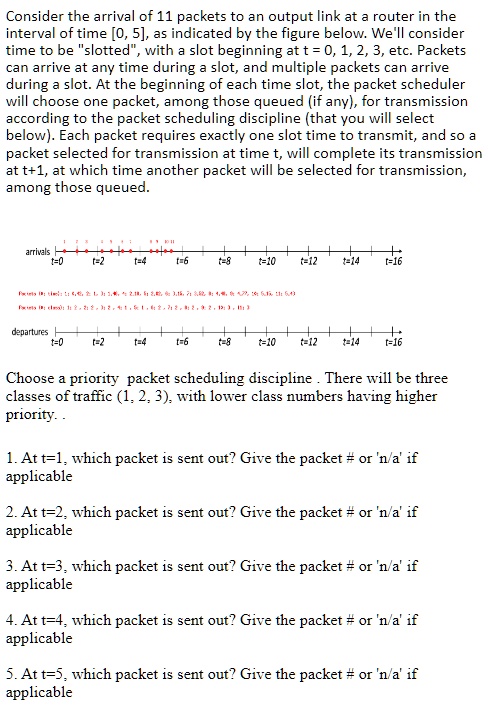
Consider the arrival of 11 packets to an output link at a router in the interval of time 0,5, as indicated by the figure below. We'll consider time to be "slotted", with a slot beginning at t=0,1,2,3, etc. Packets can arrive at any time during a slot, and multiple packets can arrive during a slot. At the beginning of each time slot, the packet scheduler will choose one packet, among those queued (if any), for transmission according to the packet scheduling discipline (that you will select below). Each packet requires exactly one slot time to transmit, and so a packet selected for transmission at time t, will complete its transmission at t+1, at which time another packet will be selected for transmission, among those queued. Choose a priority packet scheduling discipline. There will be three classes of traffic (1,2,3), with lower class numbers having higher priority. At t=1, which packet is sent out? Give the packet # or ' (n)/(a) ' if applicable At t=2, which packet is sent out? Give the packet # or ' (n)/(a) ' if applicable At t=3, which packet is sent out? Give the packet # or ' (n)/(a) ' if applicable At t=4, which packet is sent out? Give the packet # or ' (n)/(a) ' if applicable At t=5, which packet is sent out? Give the packet # or ' (n)/(a) ' if applicable Consider the arrival of 11packets to an output link at a router in the interval of time [0,5], as indicated by the figure below.We'll consider time to be "slotted", with a slot beginning at t =0,1,2, 3, etc. Packets can arrive at any time during a slot, and multiple packets can arrive during a slot. At the beginning of each time slot,the packet scheduler will choose one packet, among those queued (if any), for transmission according to the packet scheduling discipline (that you will select below). Each packet requires exactly one slot time to transmit, and so a packet selected for transmission at time t,will complete its transmission at t+1, at which time another packet will be selected for transmission, among those queued. arrivals t=0 t=2 t=4 t=6 8= t=10 t=12 t=14 t=16 departures t=0 t=2 t=4 t=6 t=8 t=10 t=12 14 Choose a priority packet scheduling discipline .There will be three classes of traffic (1; 2,3). with lower class numbers having higher priority.- 1. At t=1, which packet is sent out? Give the packet # or n/a' if applicable 2. At t=2, which packet is sent out? Give the packet # or 'n/a' if applicable 3. At t=3. which packet is sent out? Give the packet # or 'n/a' if applicable 4. At t=4, which packet is sent out? Give the packet # or 'n/a' if applicable 5. At t=5. which packet is sent out? Give the packet # or 'n/a' if applicable
View Answer
divider
BEST MATCH

Explanation: In problem 1, pq means the last two digits of each student's student number. For example, for a person with student number 933150035, the number pq will be 35 or (-40 + pq) will be -5. For the following problem, find the points that have the necessary KKT condition. Are these points optimal points? Minimize $f = x_1^2 + x_2^2 + 10x_1 + 20x_2 + 25$ subject to $g = x_1^2 + x_2^2 - 40 + pq \le 0$

View Answer
divider