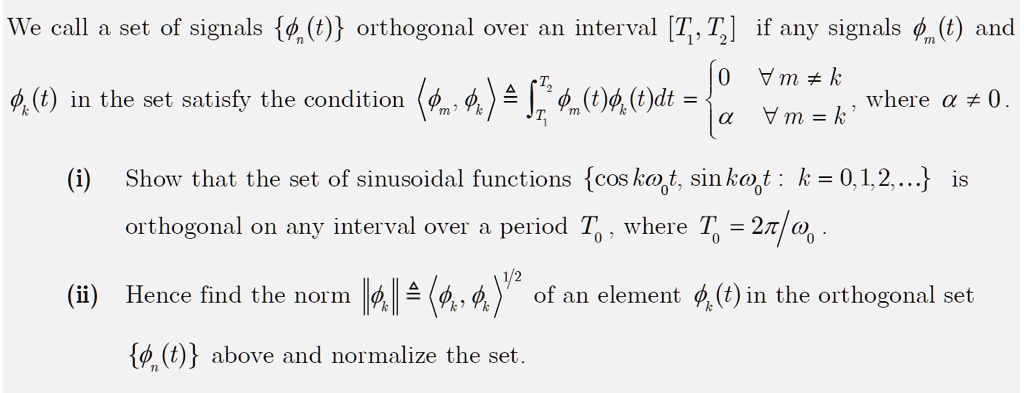
We call a set of signals \{$\phi_n(t)$\} orthogonal over an interval [$T_1, T_2$] if any signals $\phi_m(t)$ and
$\phi_k(t)$ in the set satisfy the condition $\langle \phi_m, \phi_k \rangle \equiv \int_{T_1}^{T_2} \phi_m(t)\phi_k(t)dt = \begin{cases} 0 & \forall m \neq k\\ \alpha & \forall m = k \end{cases}$ where $\alpha \neq 0$.
(i) Show that the set of sinusoidal functions \{cos $k\omega_0 t$, sin $k\omega_0 t$: k = 0,1,2,...\} is
orthogonal on any interval over a period $T_0$, where $T_0 = 2\pi/\omega_0$.
(ii) Hence find the norm $||\phi_k|| \equiv \langle \phi_k, \phi_k \rangle^{1/2}$ of an element $\phi_k(t)$ in the orthogonal set
\{$\phi_n(t)$\} above and normalize the set.