2. The "BAC-CAB" identity, A × (B x C) = B(AC) - C(AB), can be proved by the
following steps (that further test your understanding of the dot and cross products of vectors).
(a) Show that the identity holds for the case where B and C are along the same axis - i.e., B =
sc for any real number s.
(b) Now suppose B and C are along different axes, so that they define a plane. Let A = A₁ + A,
where A₁ is the projection of A perpendicular to the B-C plane, and A is the projection parallel
to this plane. Explain why Ả₁ × (B x C) and B(A₁C) - C(AB) are both equal to zero.
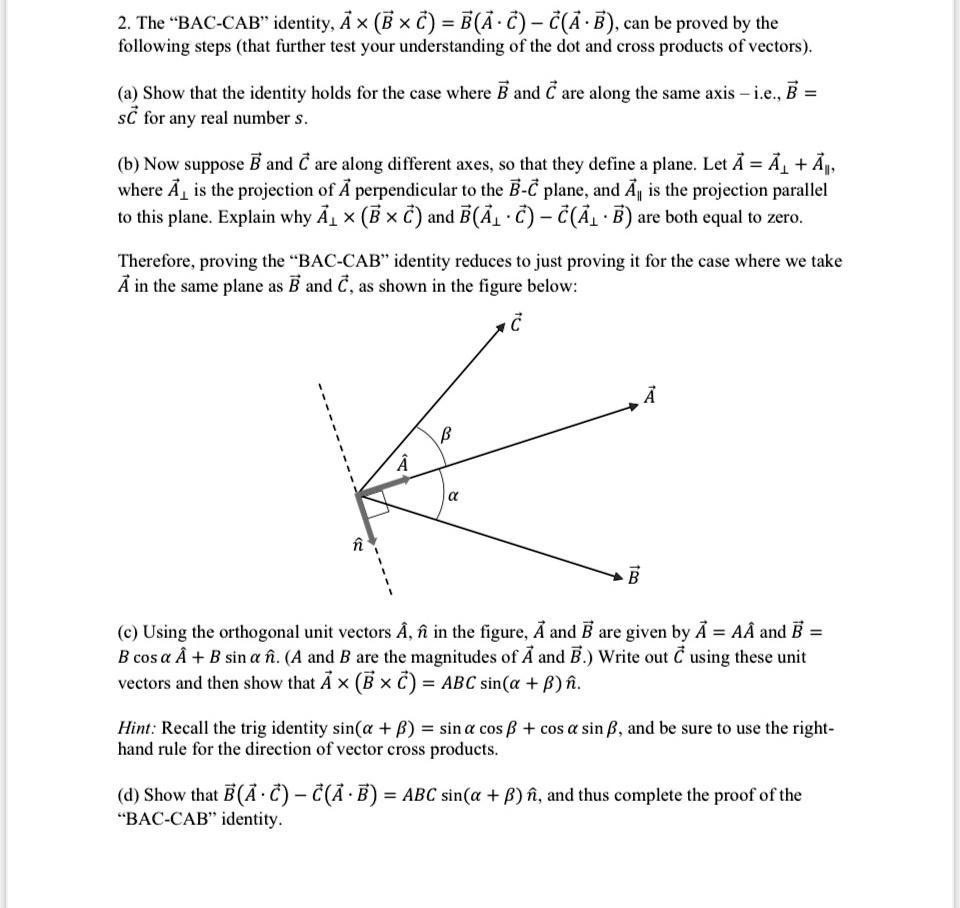
Therefore, proving the "BAC-CAB" identity reduces to just proving it for the case where we take
A in the same plane as B and C, as shown in the figure below:
ทิ
β
A
α
C
B
A
(c) Using the orthogonal unit vectors Â, î in the figure, A and B are given by A = AA and B =
B cos a A + B sin a îî. (A and B are the magnitudes of A and B.) Write out using these unit
vectors and then show that A × (B x C) = ABC sin(α + β) ñ.
Hint: Recall the trig identity sin(a + b) = sin a cos ẞ + cos a sin ẞ, and be sure to use the right-
hand rule for the direction of vector cross products.
(d) Show that B (AC) - C(AB) = ABC sin(a + ẞ) î, and thus complete the proof of the
"BAC-CAB" identity.