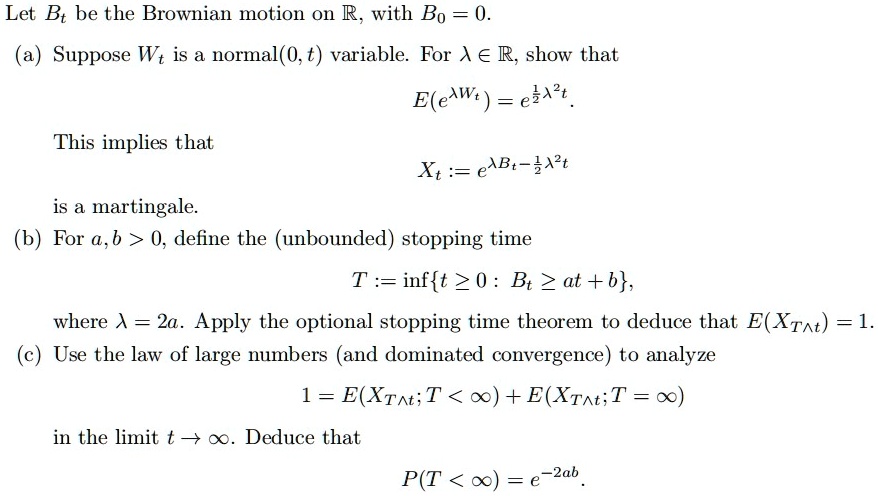
Let B_t be the Brownian motion on R, with B_0=0.
(a) Suppose W_t is a normal (0,t) variable. For λ in R, show that
E(e^(λW_t))=e^((1)/(2)λ^(2)t)
This implies that
X_t:=e^(λB_t-(1)/(2)λ^(2)t)
is a martingale.
(b) For a,b>0, define the (unbounded) stopping time
T:=inf{t>=0:B_t>=at+b},
where λ=2a. Apply the optional stopping time theorem to deduce that E(X_T^())t)=1.
(c) Use the law of large numbers (and dominated convergence) to analyze
1=E(X_T^())t;T<∞)+E(X_T^())t;T=∞)
in the limit t->∞. Deduce that
P(T<∞)=e^(-2ab)
Let B. be the Brownian motion on R.with B_0=0.
a Suppose Wt is a normal(0,t variable.For X e R,show that
E(eW)=e2t
This implies that
X=eB-2t
is a martingale
(b) For a,b > 0, define the (unbounded) stopping time
T=inf{t0:Btat+b}
c Use the law of large numbers (and dominated convergence to analyze
1=EXTt;T<+E(XTxt;T=
in the limit t-o.Deduce that
P(T<o)=e-2ab