Ace - AI Tutor
Ask Our Educators
Textbooks
My Library
Flashcards
Scribe - AI Notes
Notes & Exams
Download App
jason peral

jason p.

Divider

Questions asked

BEST MATCH

Joshua has been complaining about pyrosis after his meals. Which of the following is probably the primary cause of this condition? Peristalsis is too slow. The cardiac sphincter contracts too often. The bolus of food in the esophagus is too big. The lower esophageal sphincter remains open for too long.

View Answer
divider
BEST MATCH

One likely result of an effective or binding price ceiling is that

View Answer
divider
BEST MATCH

Intro Nautilus Clothing's stock has a 60% chance of producing a 15% return, a 20% chance of producing a 19% return, and a 20% chance of producing a -6% return. Part 1 What is the stock's expected return? 3+ decimals Submit Attempt 4/10 for 8 pts.

View Answer
divider
BEST MATCH

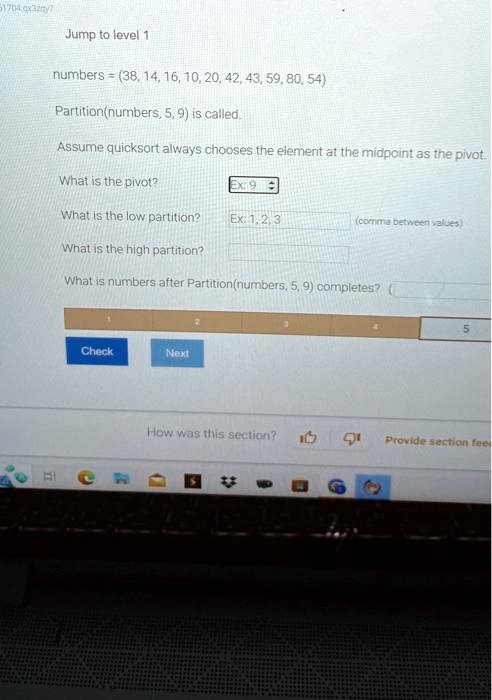
Jump to level 1 numbers = (38, 14, 16, 10, 20, 42, 43, 59, 80, 54) Partition(numbers, 5, 9) is called. Assume quicksort always chooses the element at the midpoint as the pivot. What is the pivot? What is the low partition? What is the high partition? What is numbers after Partition(numbers, 5, 9) completes?
View Answer
divider
BEST MATCH

Let and Determine the value of each of the following: (a) $g(-5) = 0$ (b) $g(-3) = 3$ (c) $g(2) = $ (d) $g(4) = $ (e) The absolute maximum of $g(x)$ occurs when $x = $ and is the value $ $ It may be helpful to make a graph of $f(x)$ when answering these questions. $f(x) = \begin{cases} 0 & \text{if } x < -4 \\ 3 & \text{if } -4 \le x < 1 \\ -5 & \text{if } 1 \le x < 3 \\ 0 & \text{if } x \ge 3 \end{cases}$ $g(x) = \int_{-4}^{x} f(t)dt$

View Answer
divider
BEST MATCH

Evaluate \(\vec{F} \cdot d\vec{r}\), where \(\vec{F}(x, y) = (x^2 + y + 2)\vec{i} + (xy)\vec{j}\) for each of the following curves: (a) C is the portion of \(y = x^2 - 2\) from \(x = -3\) to \(x = 3\) (b) C is the line segment from \((-3, 5)\) to \((1, 4)\)

View Answer
divider
BEST MATCH

Problem 1. (1 point) Let $f(x) = \sqrt{1 - x}$ and $g(x) = \sqrt{25 - x^2}$. Find $f + g$, $f - g$, $f \cdot g$, and $\frac{f}{g}$, and their respective domains. 1. $f + g = \boxed{} 2. What is the domain of $f + g$? Answer (in interval notation): $\boxed{} 3. $f - g = \boxed{} 4. What is the domain of $f - g$? Answer (in interval notation): $\boxed{} 5. $f \cdot g = \boxed{} 6. What is the domain of $f \cdot g$? Answer (in interval notation): $\boxed{} 7. $\frac{f}{g} = \boxed{} 8. What is the domain of $\frac{f}{g}$? Answer (in interval notation): $\boxed{}$

View Answer
divider
BEST MATCH

For the following standard boost converter, given the original circuit diagram and the small signal model as shown in the figure. L R$_1$ $i_L$ +\(V_s\) • Small-signal model L R$_1$ 1:D +\(V_s\) $\frac{V_o}{D}$d + $I_Ld$ R$_c$ R$_o$ $V_o$ C The duty ratio to output transfer function can be derived as $\frac{\hat{v}_o(s)}{\hat{d}(s)} = G_{vd}(s) = K_{vd}\frac{(1-\frac{s}{\omega_1})(1+\frac{s}{\omega_2})}{1+\frac{s}{Q\omega_o}+\frac{s^2}{\omega_o^2}}$ where $K_{vd} = \frac{V_s}{(1-D)^2} = 100$ $\omega_o = \sqrt{\frac{(1-D)^2}{LC}} = 250$ $Q = R\sqrt{(1-D)^2}C = 2$ $\omega_1 = \frac{L}{(1-D)^2R} = 1000$ $\omega_2 = \frac{1}{CR_c} = 10000$ Sketch the Bode plot for this non-minimum phase system. (4) (5) (6) (7) (8) (9)

View Answer
divider
BEST MATCH

Question 14 It may be possible to prepare liquid benzene from gaseous acetylene (ethyne) according to the following unbalanced reaction at 298 K: $C_2H_2(g) \rightleftharpoons C_6H_6(l)$ $S^\circ C_6H_6(l) = 172.8 \text{ J.K}^{-1}.\text{mol}^{-1}$ $S^\circ C_2H_2(g) = 200.85 \text{ J.K}^{-1}.\text{mol}^{-1}$ $\Delta H_{sys} = -632.0 \text{ kJ}$ $\Delta G = -503.86 \text{ kJ}$ (a) Predict the sign of $\Delta S_{sys}$ and explain your reasoning. $\Delta H_{sys} = -632.0 \text{ kJ } \Delta G = -503.86 \text{ kJ}$ (b) Calculate $\Delta S_{sys}$, $\Delta S_{surr}$ and $\Delta S_{universe}$. Determine if the reaction is spontaneous. (c) Is the reaction always spontaneous? Explain briefly. (d) A new voltaic cell containing Ni/Ni$^{2+}$ and a H$_2$/H$^+$ half-cell is constructed under the following conditions: [Ni$^{2+}$] = 0.020 M; [H$^+$] = 2.5 M; P(H$_2$) = 0.30 atm. Reduction potentials: $2H^+(aq) + 2e^- \rightarrow H_2(g) \text{ ; } 0.00 \text{ V}$ $Ni^{2+}(aq) + 2e^- \rightarrow Ni(s) \text{ ; } -0.25 \text{ V}$ (i) Write a balanced equation for the overall cell reaction. (ii) Calculate $E^\circ_{cell}$. (iii) Calculate Q. (iv) Calculate $E_{cell}$. Is the forward reaction spontaneous? Explain.

View Answer
divider
BEST MATCH

Q4: Find $V_a$ when $t<0$, $t>0$ and $t=\infty$.

View Answer
divider