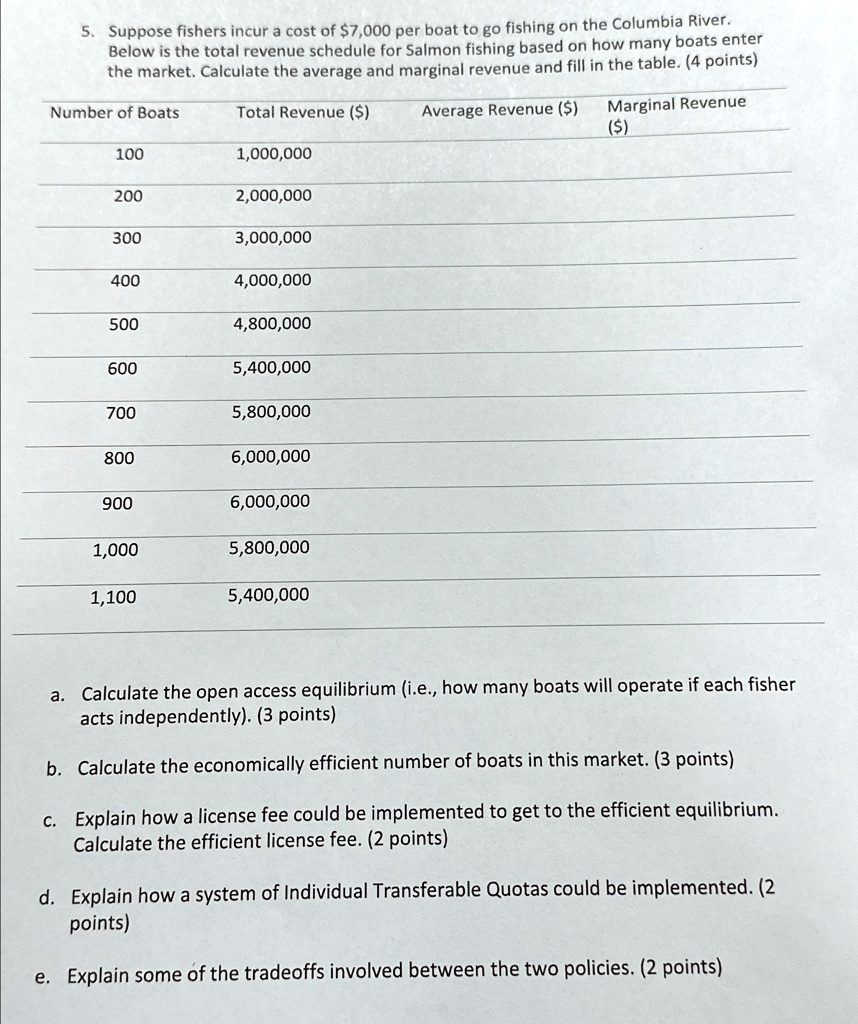
Suppose fishers incur a cost of $7,000 per boat to go fishing on the Columbia River. Below is the total revenue schedule for Salmon fishing based on how many boats enter the market. Calculate the average and marginal revenue and fill in the table. ( 4 points)
able[[Number of Boats,Total Revenue ($),Average Revenue ($), able[[Marginal Revenue],[($)]]],[100,1,000,000,,],[200,2,000,000,,],[300,3,000,000,,],[400,4,000,000,,],[500,4,800,000,,],[600,5,400,000,,],[700,5,800,000,,],[800,6,000,000,,],[900,6,000,000,,],[1,000,5,800,000,,],[1,100,5,400,000,,]]
a. Calculate the open access equilibrium (i.e., how many boats will operate if each fisher acts independently). (3 points)
b. Calculate the economically efficient number of boats in this market. ( 3 points)
c. Explain how a license fee could be implemented to get to the efficient equilibrium. Calculate the efficient license fee. ( 2 points)
d. Explain how a system of Individual Transferable Quotas could be implemented. (2 points)
e. Explain some of the tradeoffs involved between the two policies. ( 2 points)
Number of Boats
Total Revenue($)
Average Revenue($)
Marginal Revenue ($)
100
1,000,000
200
2,000,000
300
3,000,000
400
4,000,000
500
4,800,000
600
5,400,000
700
5,800,000
800
6,000,000
900
6,000,000
1,000
5,800,000
1,100
5,400,000
a.Calculate the open access equilibrium (i.e., how many boats will operate if each fisher acts independently).(3 points)
b. Calculate the economically efficient number of boats in this market. (3 points)
c.Explain how a license fee could be implemented to get to the efficient equilibrium. Calculate the efficient license fee. (2 points)
d.Explain how a system of Individual Transferable Quotas could be implemented. (2 points) e.Explain some of the tradeoffs involved between the two policies. (2 points)