Ace - AI Tutor
Ask Our Educators
Textbooks
My Library
Flashcards
Scribe - AI Notes
Notes & Exams
Download App
javad rezalyi

javad r.

Divider

Viewed Questions

Find the integral.
$$
\int \sinh (1-2 x) d x
$$

Find the integral. $$ \int \sinh (1-2 x) d x $$

Calculus

Logarithmic, Exponential, and Other…

Hyperbolic Functions

Questions asked

INSTANT ANSWER

Give an example of a function whose integral can be found using substitution, trigonometric substitution, and integration by parts. Justify your answer by doing all three techniques. (Note: your example should have never been given or discussed in the class) [30 points]

View Answer
divider
INSTANT ANSWER

B. Determine whether the statement is true or false. Explain your reason. 1. One problem involving integral can only be evaluated using one particular integration technique. 2. \( \int_{-1}^{2} \frac{1}{x} d x=[\ln |x|]_{-1}^{2}=\ln 2-\ln 1=\ln 2 \)

View Answer
divider
INSTANT ANSWER

CALCULUS \& ANALYTICAL GEOMETRY 2 UNIT 2 - INTEGRATION TECHNIQUES (Part 1) A. Evaluate the following integrals. You may need to determine the technique first. 1. \( \int\left(\frac{1}{x+1}\right) d x \) 2. \( \int \frac{4 x^{3}+3}{x^{4}+3 x} d x \) 3. \( \int \frac{2 x^{2}+7 x-3}{x-2} d x \) 4. \( \int \frac{(\ln x)^{2}}{x} d x \) 5. \( \int \sinh (1-2 x) d x \) 6. \( \int \frac{\sinh x}{1+\sinh ^{2} x} d x \)

View Answer
divider
INSTANT ANSWER

1. Determine the angle between two vectors, if the magnitude of their addition and their subtraction are the same!

View Answer
divider
BEST MATCH

2. Determine the angle between \( \mathbf{A} \) and \( \mathbf{B} \) if \( |\mathbf{A}|=10,|\mathbf{B}|=15 \), and \( |\mathbf{A}+\mathbf{B}|=20 \) !

View Answer
divider
BEST MATCH

3. For the vectors: - \( \quad \mathbf{A}=4 \boldsymbol{i}+7 \boldsymbol{j}+6 \boldsymbol{k} \) - \( \quad \mathbf{B}=-3 \boldsymbol{i}+\boldsymbol{j}-7 \boldsymbol{k} \) - \( \quad \mathbf{C}=5 \boldsymbol{i}-2 \boldsymbol{j}+\boldsymbol{k} \) Determine: a. The resultant of the three vectors! b. The angle between the resultant vector with the \( x \)-axis, \( y \)-axis and \( z \)-axis!

View Answer
divider
INSTANT ANSWER

4. Determine whether the projection of each vectors below, directed in the same, opposite or normal with respect to \( \mathbf{A}=3 \boldsymbol{i}-2 \boldsymbol{j}+\boldsymbol{k} \) : a. \( \boldsymbol{i}+\boldsymbol{j}-2 \boldsymbol{k} \) b. \( 4 \boldsymbol{i}-3 \boldsymbol{j}+4 \boldsymbol{k} \) c. \( 2 \boldsymbol{i}+4 \boldsymbol{j}+2 \boldsymbol{k} \)

View Answer
divider
ANSWERED

Penny Riley verified

Numerade educator

3. A 20. kg object oscillates at the end of a vertical spring that has a spring constant of 4.1 × 10? N/m. The effect of air resistance is represented by the damping coefficient b = 2.50 N.s/m, and so the oscillation of the system is damped. Determine a. Calculate the frequency of the damped oscillation! b. Describes the type of the damping here! c. By what percentage does the amplitude of the oscillation decrease in each cycle?

View Answer
divider
ANSWERED

Timothy James verified

Numerade educator

2. A wave on a string with mass of 1 kg and total length of 20 m is described by the wave function y(x, t) = 0.1 cos(0.25x - 10t) m. A light bug is located on the x = 12 m. Evaluate: a. Shows that the bug will experience simple harmonic motion! (Express the position as a function of time). b. Determine the phase constant of the SHM of the bug! c. The tension on the string!

View Answer
divider
ANSWERED

Supratim Pal verified

Numerade educator

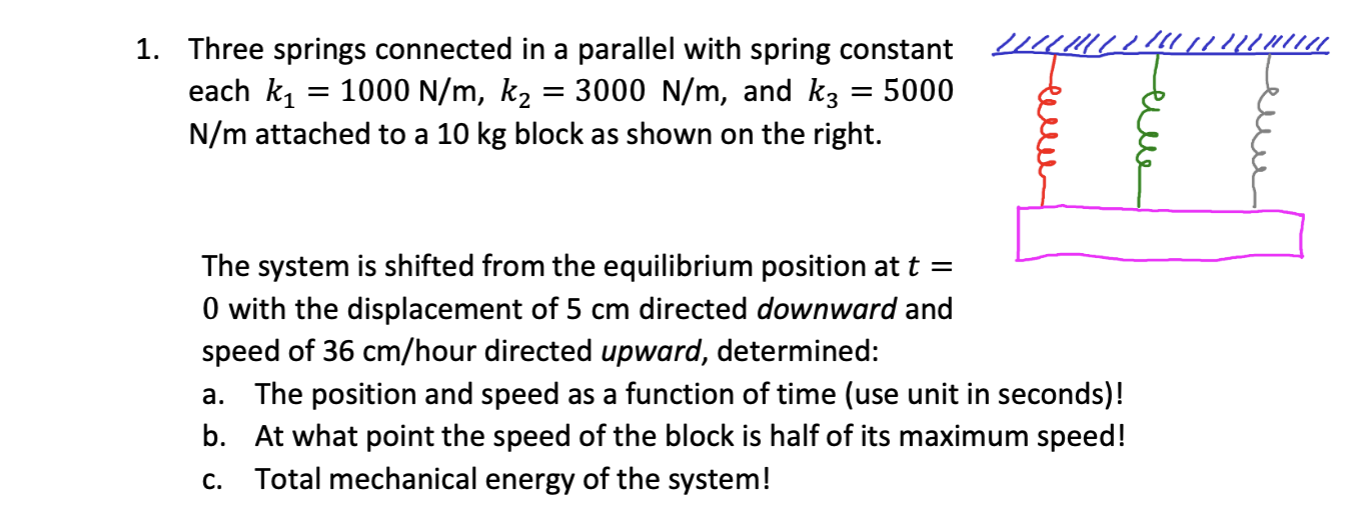
1. Three springs connected in a parallel with spring constant each k1 = 1000 N/m, k2 = 3000 N/m, and k3 = 5000 N/m attached to a 10 kg block as shown on the right. The system is shifted from the equilibrium position at t = 0 with the displacement of 5 cm directed downward and speed of 36 cm/hour directed upward, determined: a. The position and speed as a function of time (use unit in seconds)! b. At what point the speed of the block is half of its maximum speed! c. Total mechanical energy of the system!
View Answer
divider