Ace - AI Tutor
Ask Our Educators
Textbooks
My Library
Flashcards
Scribe - AI Notes
Notes & Exams
Download App
javier eaton

javier e.

Divider

Questions asked

BEST MATCH

Find the derivative of f(x)=(7e^(2x))/(e^(5x) 1) a.) f^(')(x)=(14e^(2x))/(5e^(5x)) b.) f^(')(x)=(49e^(7x) 14e^(2x))/((e^(5x) 1)^(2)) c.) f^(')(x)=(21e^(7x)-14e^(2x))/((e^(5x) 1)^(2)) d.) f^(')(x)=(-21e^(7x) 14e^(2x))/((e^(5x) 1)^(2))

View Answer
divider
BEST MATCH

When does the process of myelination complete? Multiple Choice During the first trimester of pregnancy During adolescence Just prior to birth Within in the first year of life

View Answer
divider
BEST MATCH

Nicotine is a Multiple Choice depressant. stimulant. narcotic. sedative.

View Answer
divider
BEST MATCH

How does recent research challenge traditional views regarding the origins of organized long-distance trade, particularly about the Mesolithic Age and the trading of obsidian?

View Answer
divider
BEST MATCH

Name: Student ID: Q1. Determine the reaction that occurs between each of the chemicals below. Write the molecular and net ionic equation for each. A. Sodium Sulfite and Zinc (II) Chloride $Na_2SO_3 + ZnCl_2 \rightarrow 2NaCl + ZnS$ $Zn + SO_3^{2-} \rightarrow ZnSO_3$ $Zn + S \rightarrow ZnS$ B. Sodium hydroxide and Hydrobromic acid $NaOH + HBr \rightarrow NaBr + HOH$ $OH^- + H^+ \rightarrow H_2O$ C. Ammonium Nitrate and Lithium Carbonate $NH_4(NO_3) + Li_2(CO_3) \rightarrow (NH_4)_2CO_3 + 2Li(NO_3)$ $Li^+ + CO_3^{2-} \rightarrow Li_2CO_3$ $2(NH_4)(NO_3) + Li_2(CO_3) \rightarrow 2LiNO_3 + (NH_4)_2CO_3$

View Answer
divider
BEST MATCH

refers to the source, format, assumptions and constraints, and other facts about the data. ? Metadata ? Outsourced data ? Clickstream data ? Dimensional data ? Attributed data

View Answer
divider
BEST MATCH

1. In-Kind and Cash Transfers Consider an individual who derives their utility from housing consumption (h) and non-housing consumption (c): u(c, h) The individual maximizes utility subject to a budget constraint: Pcc + phh = y a) graph the consumer's budget constraint, and a corresponding optimizing consumption bundle (assume that the household consumes a mix of housing and non-housing) • Now suppose that the government provides an in-kind proportional rent subsidy equal to \alpha of the households total housing expense b) write the new budget constraint under subsidy program, and graph the new budget constraint c) plot the corresponding optimizing consumption bundle under the new constraint (assume that the house- hold consumes a mix of housing and non-housing) and label the level of housing consumption $h_{IK}$ • Now suppose instead of providing the individual an in-kind subsidy, the government provides a cash grant equal to the size of the government outlay under in-kind proportional rent subsidy. d) write the new budget constraint under the equivalent cash subsidy program, and graph the new budget constraint e) does the cash grant increase housing consumption by more, less or the same as the in-kind transfer? do you know? f) does the cash grant lead to higher, lower, or the same utility as the in-kind transfer? do you know?

View Answer
divider
BEST MATCH

2. Consider the random variables X and Y with joint PDF given in Eq (1) $f_{XY}(x, y) = \begin{cases} k \left(x + \frac{1}{3}\right) & x, y > 0, \ x + y < 1 \\ 0 & \text{otherwise} \end{cases}$ (a) determine the value of k (b) find $\mu_x$ (c) find $\sigma_y$ (d) find $\sigma_{XY}$ (e) find $\rho_{XY}$

View Answer
divider
BEST MATCH

Determine the Einstein Temperature of Diamond and another solid of your choosing. Show your work for full credit.

View Answer
divider
BEST MATCH

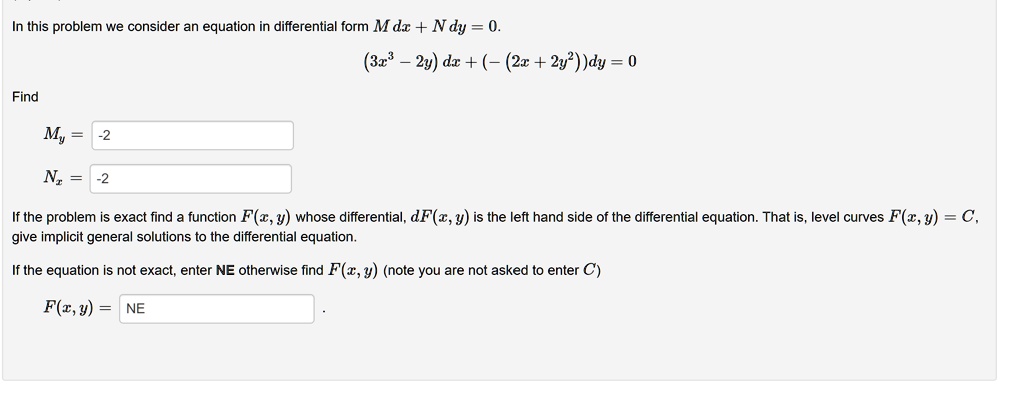
In this problem we consider an equation in differential form $M \, dx + N \, dy = 0$. $(3x^3 - 2y) \, dx + (-(2x + 2y^2)) \, dy = 0$ Find $M_y = -2$ $N_x = -2$ If the problem is exact find a function $F(x, y)$ whose differential, $dF(x, y)$ is the left hand side of the differential equation. That is, level curves $F(x, y) = C$, give implicit general solutions to the differential equation. If the equation is not exact, enter NE otherwise find $F(x, y)$ (note you are not asked to enter C) $F(x, y) = NE$
View Answer
divider