Ace - AI Tutor
Ask Our Educators
Textbooks
My Library
Flashcards
Scribe - AI Notes
Notes & Exams
Download App
javier gates

javier g.

Divider

Questions asked

BEST MATCH

To 1.0 L of a 0.38 M solution of HClO2 is added 0.15 mol of NaClO. Calculate the [HClO2] at equilibrium.

View Answer
divider
BEST MATCH

If the standard reduction potential of a certain half-reaction is -0.30 V, which statement below is TRUE for this half-reaction to proceed as a reduction? This half-reaction will proceed if it is coupled to another half-reaction that has a standard reduction potential less than -0.30 V. This half-reaction will proceed if it is coupled to another half-reaction that has a standard reduction potential greater than +0.30 V. This half-reaction will proceed if it is coupled to another half-reaction that has a standard reduction potential greater than -0.30 V. It doesn't matter what half-reaction this is coupled with; it will proceed spontaneously.

View Answer
divider
BEST MATCH

5. Consider the function $w = [z^2 - (2 + i)^2]^{\frac{1}{2}}$. Insert branch cuts so that real(w) is positive or zero for whatever z is located in the z-plane.

View Answer
divider
BEST MATCH

what are the most common risk areas in a health care organization that require compliance attention?

View Answer
divider
BEST MATCH

Problem: the Solow growth model with a Cobb-Douglas technology of production. Consider the following continuous-time economy with time indexed by $t \ge 0$. The economy is populated by identical households. The population of households at time $t > 0$ is $L(t) > 0$ and is exogenous. The economy is also composed of a large number of identical competitive producers which have access to a technology that uses capital and labour to produce a final homogeneous good $Y(t) \ge 0$ that can be used for consumption $C(t) \ge 0$ and investment $I(t)$. Capital is held by households and has stock denoted by $K(t) > 0$; each household supplies one unit of labour at each time so total employment is equal to population $L(t)$. Using the fact that all producers all identical, we will consider a representative producer for this economy. We assume that the aggregate production function takes the following Cobb- Douglas form: $Y(t) = F(K(t), L(t),t) = (A_K(t)K(t))^\alpha (A_L(t)L(t))^\beta$, (1) where $\alpha > 0$ and $\beta > 0$ are parameters and where $A_K(t) > 0$ and $A_L(t) > 0$ are, respectively, capital and labour-augmenting technological factors governing the efficiency of these inputs. Households and producers exchange labour and capital in the markets for inputs; the wage rate is $w(t)$ and the rental rate of capital is $R(t)$. Markets are competitive and households and producers are price-takers, i.e., they treat the prices as given. The growth rate of the population is exogenous and constant and given by $n > 0$, and the inital population level is $L(0) = L_0$. The growth rate of the technology indexes $A_K$ and $A_L$ are denote by $g_K \ge 0$ and $g_L \ge 0$, respectively (assumed to be exogenous and constant as well). The capital stock accumulates following $\dot{K}(t) = I(t) - \delta K(t)$, (2) where $\dot{X}(t)$ designates the time derivative of a given variable $X(t)$, and $\delta > 0$ represents the depreciation rate of capital. The initial aggregate capital stock $K(0) = K_0 > 0$ is given. Finally, the household's savings rate is exogenous and given by $s \in (0,1)$. The flow of aggregate savings at time $t$ is denoted by $S(t)$. 1

View Answer
divider
BEST MATCH

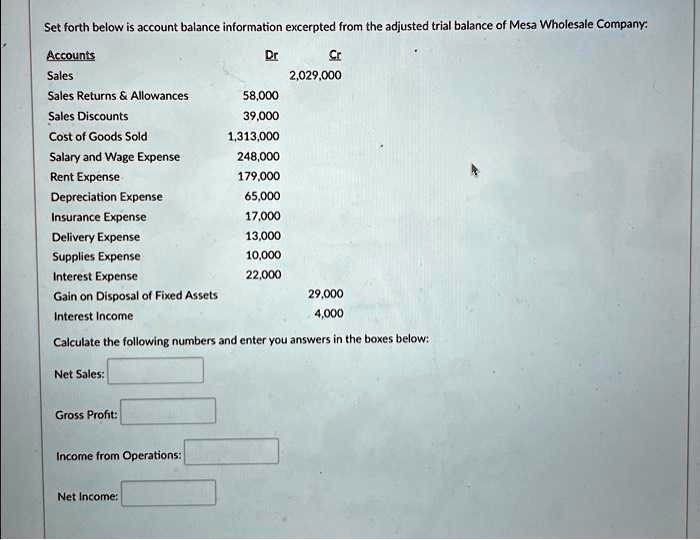
Set forth below is account balance information excerpted from the adjusted trial balance of Mesa Wholesale Company: Accounts Dr Cr Sales 2,029,000 Sales Returns & Allowances 58,000 Sales Discounts 39,000 Cost of Goods Sold 1,313,000 Salary and Wage Expense 248,000 Rent Expense 179,000 Depreciation Expense 65,000 Insurance Expense 17,000 Delivery Expense 13,000 Supplies Expense 10,000 Interest Expense 22,000 Gain on Disposal of Fixed Assets 29,000 Interest Income 4,000 Calculate the following numbers and enter you answers in the boxes below: Net Sales: Gross Profit: Income from Operations: Net Income:
View Answer
divider
BEST MATCH

1. [60%] Solve the 0/1 Knapsack problem using the backtracking algorithm: (a) print the profit, weight and bound for each node according to the order that is first visited in the implicit pruned state space tree. (b) print the total profit and weight for the final solution; and (c) print the selected items together with their profits and weights for the final solution. Compare the result to the result you have got from Program Assignment 4. If you have implemented the backtracking algorithm correctly, the total profit achieved by this backtracking method must be equal to that achieved by the brute force method from Program Assignment 4. • Your program should be invoked as follows by taking knapsack01.txt as an input file and output a text file called entries3.txt and output3.txt. The format of knapsack01.txt is same as that from Program Assignment 4. The format of output3.txt should be same as output1.txt (from Program Assignment 4). The format of entries3.txt should be as follows. $> backtrack knapsack01.txt knapsack01.txt 4 24 Item1 10 7 Item2 13 9 Item3 21 10 Item4 24 15 The first line contains the number items and the weight capacity of the knapsack. Each of the following lines contains the name of the item (you can just use item1 to item10), the profit of the item, and the weight of the item. entries3.txt (assuming that you have 4 items to choose) 1 0 0 0 2 \textless{}profit2\textgreater{} \textless{}weight2\textgreater{} \textless{}bound2\textgreater{} 3 \textless{}profit3\textgreater{} \textless{}weight3\textgreater{} \textless{}bound3\textgreater{} ...... Each row starts with the visiting order of node, followed by its profit, weight, and upper bound in the pruned state space tree.

View Answer
divider
BEST MATCH

The number of bacteria in a culture is given by the model $N(t) = 200e^{0.4t}$ where t is the time in hours. Calculate the time in hours that the culture needs to grow to reach a size of 800 bacteria. Round your answer to the nearest tenth.

View Answer
divider
BEST MATCH

7. Using Binary Search, write down step by step process in order to find the target. Show begin, mid, and end value in each iteration. 8 13 i. Target = 88 ii. Target=8 iii. Target=40 17 26 44 56 88 97

View Answer
divider
BEST MATCH

9:04 4 < Back JavaFIN-20-21 PART B......docx Ma Marka M Mark Marke Part 1-2 25 1ª Marker Signature Signature Part B: Programming Instructions: (25marks) 2d Marker Examination Committee Copy and paste your programs below each respective questions. Keep also screen shots of your sample input and output screens after your program codes. Save and submit your file in Moodle 5 to 10 minutes before the time. Write a Java program that will input user in an Online Banking registration. (5*1-5marks) The program should allow user to enter any 3 information of the user and 2 bank details that may be needed for the next requirements. It must assign and display the registration fee which is 12.500 rials for new and 6.700 rials for old customers. The program should allow to enter another user or to make multiple/many registrations. Display all information entered and processed in this program. Include other required statements to run the Taxi Booking program properly. 21 Oman Pharmacy has announced offers on their products to during COVID-19 pandemic. customers marks) (20 Write Java program with the following requirements: Create a superclass for the Pharmacy with the following requirements: (1mark) ? Member variables: pharmacyBranch, pharmacyCode and contact Number (Imark) Member methods to: declare constructors to initialize the variables assigedipla (Imark) offer based on the

View Answer
divider