In a two-bus system, a synchronous generator is connected to a load through a lossless transmission line. The shunt charging capacitance of the transmission line is zero. The terminal voltage of the load is $1\angle 0^\circ$ pu, the internal voltage of the generator is $1.1\angle 20^\circ$ pu, the transient reactance of the generator $j0.2$ pu, the reactance of the transmission line is $j0.3$ pu.
(a) Determine the equation for the electrical power $p_e$ delivered by the generator versus the power angle $\delta$.
(b) Initially, the generator is operating at steady state with initial electrical and mechanical power $p_e = p_m = 1.0$ pu, and initial power angle $\delta_0 = 20^\circ$. At time $t_0 = 0$ sec, a three-phase short circuit occurs at the terminal of the generator, and $p_e$ instantaneously drops to zero and remains at zero during the fault. At time $t_1 = 0.05$ sec, the fault disappears and the power angle at this moment is $\delta_1 = 30^\circ$. After the fault disappears, the power angle continues increasing to its maximum value $\delta_2 = 40^\circ$.
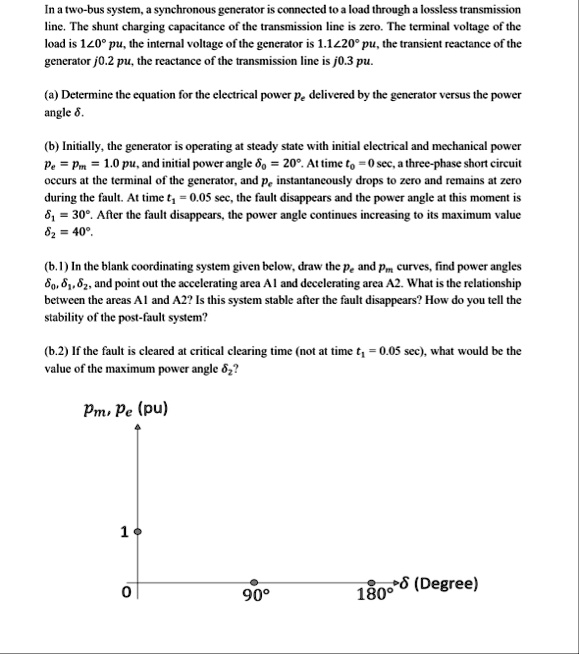
(b.1) In the blank coordinating system given below, draw the $p_e$ and $p_m$ curves, find power angles $\delta_0, \delta_1, \delta_2$, and point out the accelerating area A1 and decelerating area A2. What is the relationship between the areas A1 and A2? Is this system stable after the fault disappears? How do you tell the stability of the post-fault system?
(b.2) If the fault is cleared at critical clearing time (not at time $t_1 = 0.05$ sec), what would be the value of the maximum power angle $\delta_2$?
$p_m, p_e$ (pu)
1
0
90°
180°
$\delta$ (Degree)