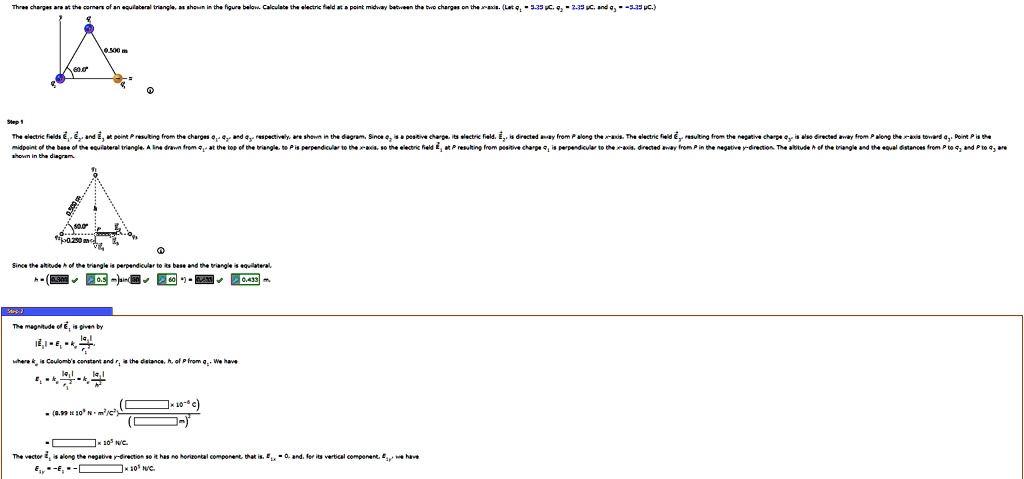
Step 1
shown in the diagram.
(i)
Since the altitude h of the triangle is perpendicular to its base and the triangle is equilateral,
h=(0.500✓0.5m)sin(60,600deg )=0.433,0.433m.
Step 2
The magnitude of vec(E)_(1) is given by
|vec(E)_(1)|=E_(1)=k_(e)(|q_(1)|)/(r_(1)^(2)),
where k_(e) is Coulomb's constant and r_(1) is the distance, h_(r of )P from q_(1). We have
E_(1)=k_(e)(|q_(1)|)/(r_(1)^(2))=k_(e)(|q_(1)|)/(h^(2))
=(8.99 imes 10^(9)(N)*(m^(2))/(C^(2)))-((◻)/((n)^(2)))
=
imes 10^(5)(N)/(C).
The vector vec(E)_(1) is along the negative y-direction so it has no horizontal component, that is, E_(1x)=0, and, for its vertical component, E_(1y^(')) we have
E_(1y)=-E_(1)=,| imes 10^(5)(N)/(C).
=5.35 C.]
The lctric fiid E,, and t int of the bese
f.isoivmb
ii,1f, -k, le,1
.99Nm/
] x 106 c] m}
F,,E,
503 N/C.