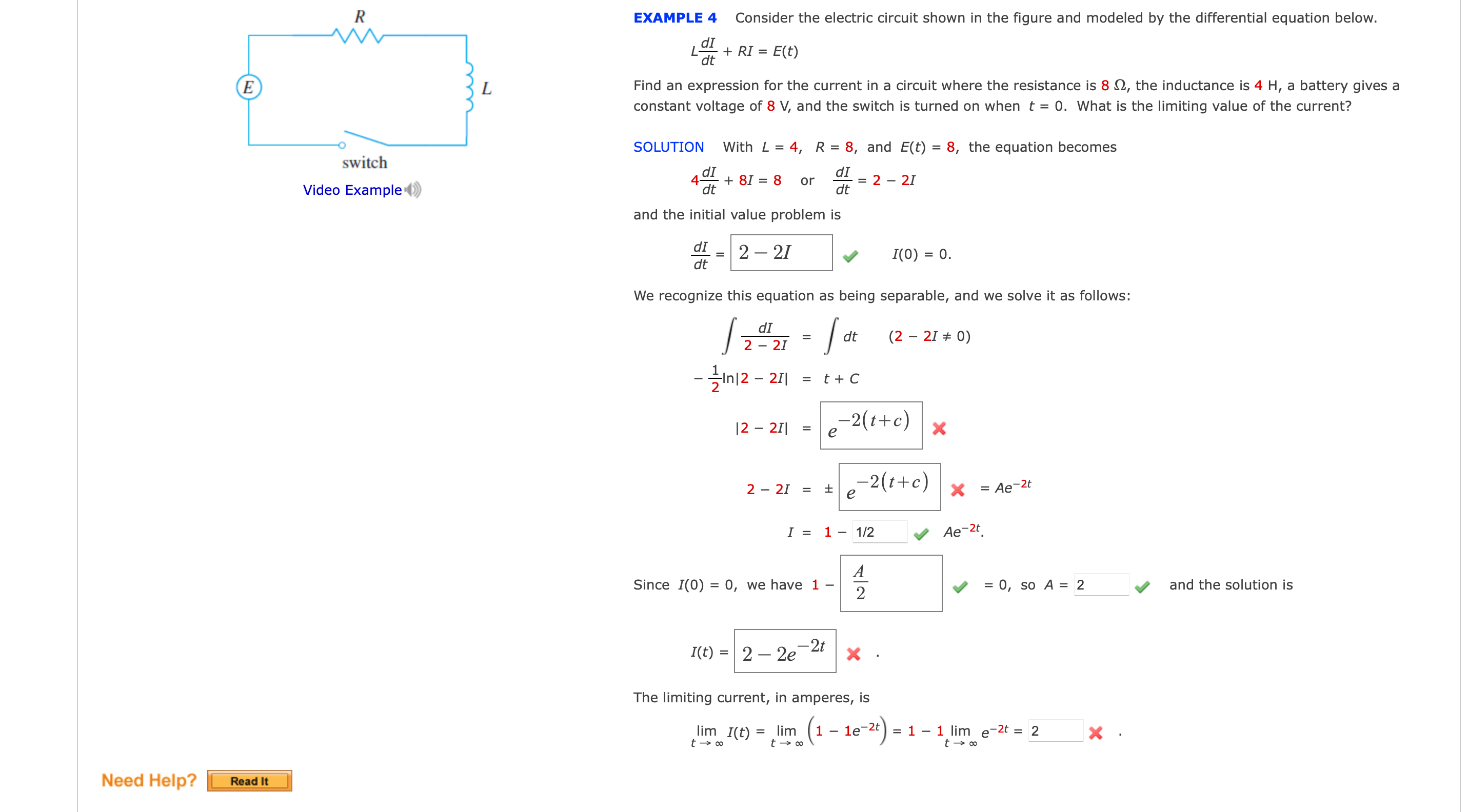
EXAMPLE 4 Consider the electric circuit shown in the figure and modeled by the differential equation below.
[ L frac{d I}{d t}+R I=E(t) ]
Find an expression for the current in a circuit where the resistance is 8 ?, the inductance is 4 H, a battery gives a constant voltage of 8 V, and the switch is turned on when t = 0. What is the limiting value of the current?
SOLUTION With L = 4, R = 8, and E(t) = 8, the equation becomes
[ 4 frac{d I}{d t}+8 I=8 quad ext{or} quad frac{d I}{d t}=2-2 I ]
and the initial value problem is
[ frac{d I}{d t}= 2-2 I quad I(0)=0. ]
We recognize this equation as being separable, and we solve it as follows:
[ int frac{d I}{2-2 I} = int d t quad (2-2 I
eq 0) ]
[ -frac{1}{2} ln |2-2 I| = t+C ]
[ |2-2 I| = e^{-2(t+c)} ]
[ 2-2 I = pm e^{-2(t+c)} = A e^{-2 t} ]
[ I = 1 - 1/2 A e^{-2 t}. ]
Since I(0) = 0, we have 1 - A/2 = 0, so A = 2 and the solution is
[ I(t) = 2-2e^{-2t} ]
The limiting current, in amperes, is
[ lim _{t
ightarrow infty} I(t) = lim _{t
ightarrow infty} (1 - 1 e^{-2t}) = 1 - 1 lim _{t
ightarrow infty} e^{-2t} = 2 ]