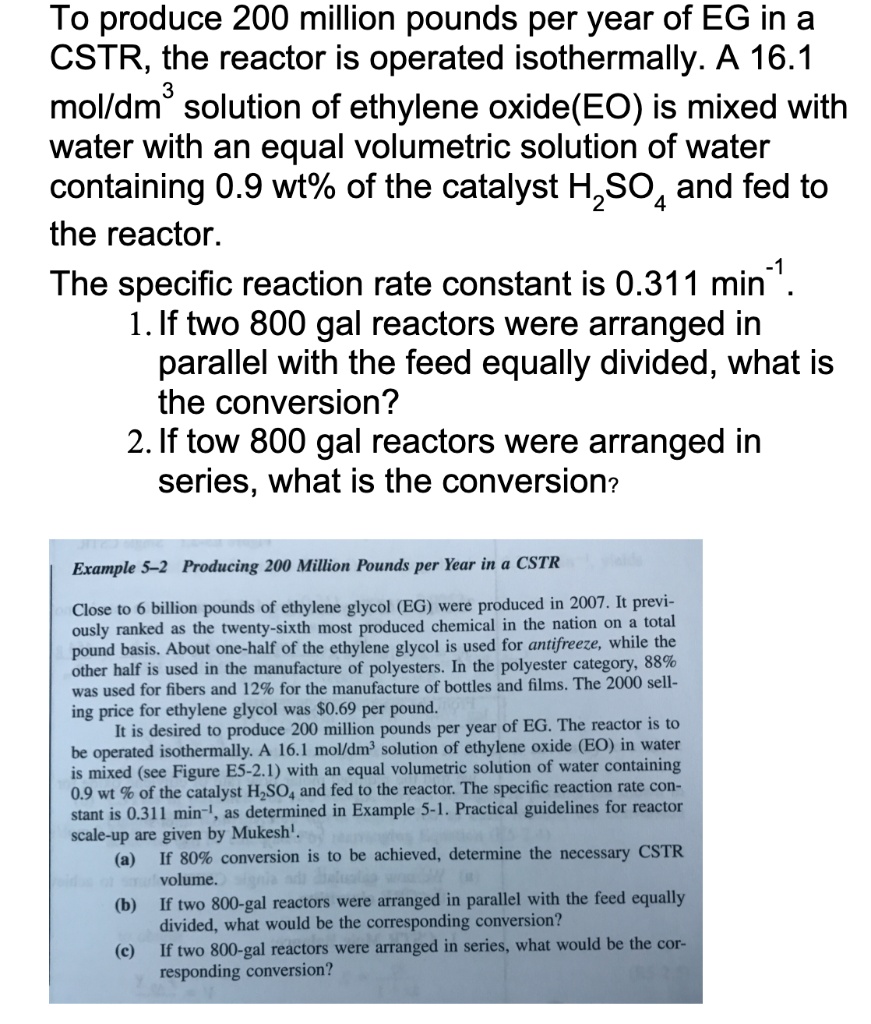
To produce 200 million pounds per year of EG in a CSTR, the reactor is operated isothermally. A 16.1 mol/dm³ solution of ethylene oxide (EO) is mixed with water with an equal volumetric solution of water containing 0.9 wt% of the catalyst H₂SO₄ and fed to the reactor.
The specific reaction rate constant is 0.311 minâ»Â¹. If two 800-gal reactors were arranged in parallel with the feed equally divided, what is the conversion? If two 800-gal reactors were arranged in series, what is the conversion?
Example 5-2: Producing 200 Million Pounds per Year in a CSTR
Close to 6 billion pounds of ethylene glycol (EG) were produced in 2007. It previously ranked as the twenty-sixth most produced chemical in the nation on a total pound basis. About one-half of the ethylene glycol is used for antifreeze, while the other half is used in the manufacture of polyesters. In the polyester category, 88% was used for fibers and 12% for the manufacture of bottles and films. The 2000 selling price for ethylene glycol was $0.69 per pound. It is desired to produce 200 million pounds per year of EG. The reactor is to be operated isothermally. A 16.1 mol/dm³ solution of ethylene oxide (EO) in water is mixed (see Figure E5-2.1) with an equal volumetric solution of water containing 0.9 wt% of the catalyst Hâ‚‚SOâ‚„ and fed to the reactor. The specific reaction rate constant is 0.311 minâ»Â¹, as determined in Example 5-1. Practical guidelines for reactor scale-up are given by Mukesh. (a) If 80% conversion is to be achieved, determine the necessary CSTR volume. (b) If two 800-gal reactors were arranged in parallel with the feed equally divided, what would be the corresponding conversion? (c) If two 800-gal reactors were arranged in series, what would be the corresponding conversion?