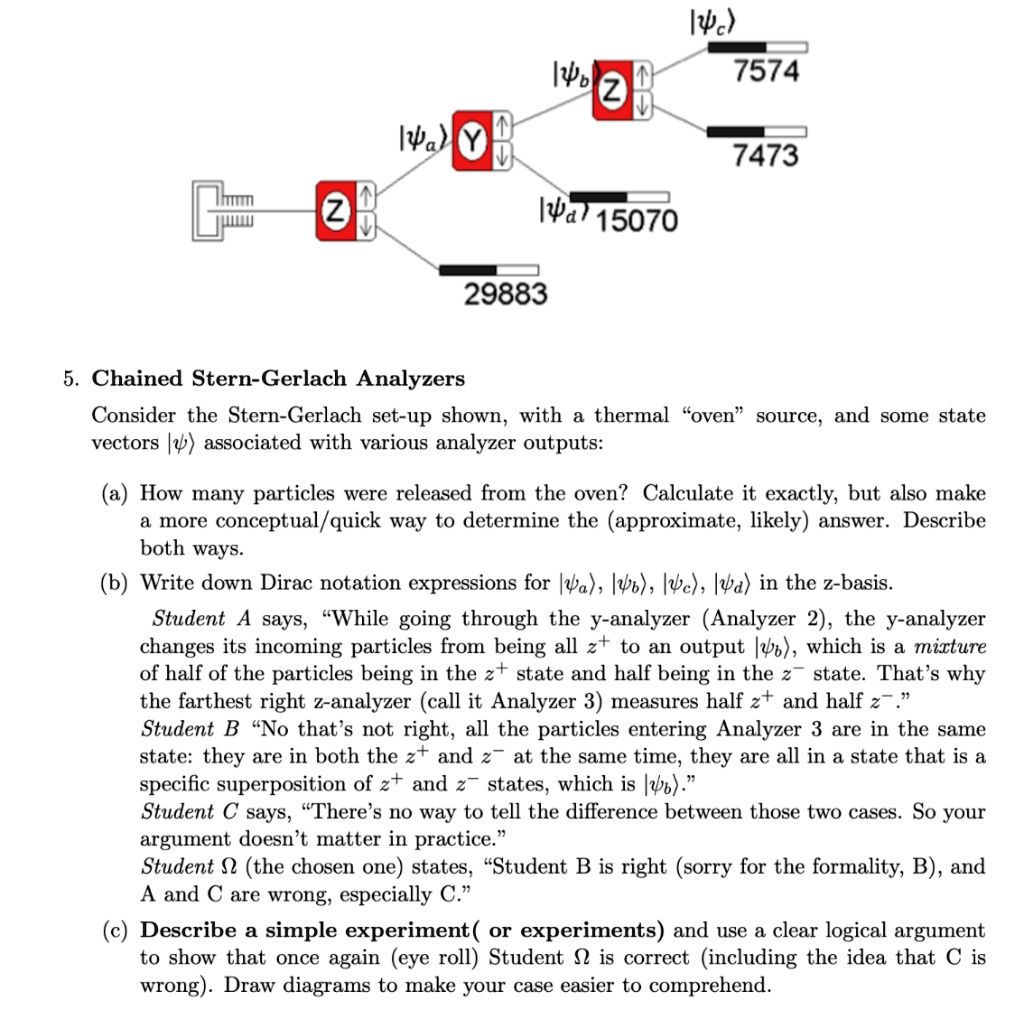
Please do part (c). Thank you!
($c > 7574)
I am Y
7473
7
|a15070
29883
5. Chained Stern-Gerlach Analyzers
Consider the Stern-Gerlach set-up shown, with a thermal "oven" source, and some state vectors |a), |b), |c, |d) associated with various analyzer outputs:
(a) How many particles were released from the oven? Calculate it exactly, but also make a more conceptual/quick way to determine the (approximate, likely) answer. Describe both ways.
(b) Write down Dirac notation expressions for |a), |b), |c), |d) in the z-basis.
Student A says, "While going through the y-analyzer (Analyzer 2), the y-analyzer changes its incoming particles from being all z+ to an output |b), which is a mixture of half of the particles being in the z+ state and half being in the z- state. That's why the farthest right z-analyzer (call it Analyzer 3) measures half z+ and half z-."
Student B says, "No, that's not right. All the particles entering Analyzer 3 are in the same state: they are in both the z+ and z- at the same time, they are all in a state that is a specific superposition of z+ and z- states, which is |c)."
Student C says, "There's no way to tell the difference between those two cases. So your argument doesn't matter in practice."
Student D (the chosen one) states, "Student B is right (sorry for the formality, B), and A and C are wrong, especially C."
(c) Describe a simple experiment (or experiments) and use a clear logical argument to show that once again (eye roll) Student D is correct (including the idea that C is wrong). Draw diagrams to make your case easier to comprehend.