Ace - AI Tutor
Ask Our Educators
Textbooks
My Library
Flashcards
Scribe - AI Notes
Notes & Exams
Download App
jeffery schaefer

jeffery s.

Divider

Questions asked

BEST MATCH

A cell in G1 of interphase has 46 chomosomes how many chromatids will be found per cell when this original cell progresses to metaphase 2 of meiosis

View Answer
divider
BEST MATCH

One type of cytopathic effect of a viral infection results in the presence of masses of viruses or damaged organelles, called \_\_\_\_\_\_\_ bodies.

View Answer
divider
BEST MATCH

Given the biochemical pathway of corn, what is the phenotype of corn with the following genotype: CC Rr AA prpr Yy? Slide7-1.PNG Group of answer choices

View Answer
divider
BEST MATCH

3. [10] Please evaluate/simplify these finite geometric series using theorems. (a) $-\frac{1}{9} + \frac{1}{3} - 1 + ... + 27$ (b) $\sum_{n=1}^{7} a_n$ where $a_3 = \frac{1}{12}$ and $a_6 = \frac{2}{3}$

View Answer
divider
BEST MATCH

For the both tasks use “Percentage split”, and set the percentage value to (your last non-zero digit of CWID * 10). For example, if your CWID is 50000003, then the percentage must be set to 30% (i.e., 3*10). If your CWID is 50000050, then the percentage must be set to 50%. Note: For any screen capture, your name and CWID must be captured together. Task 1. Classification (35 pt.) Apply classification methods to classify the diabetes dataset (“diabetes.arff”) in Weka. Follow the percentage split rule indicated above. 1.a (25pt.) Perform classification using the five classification tools: (1) Logistic regression (“Logistic”) (2) Naïve Bayes (“NaiveBayes”) (3) Decision Tree (“REPTree”), (4) kNN (“IBk”) with k=5 (5) SVM (“SMO”) For the parameter setting, set k=5 for kNN, while relying on the default parameter setting for the rest. A screenshot below shows logistic regression method. The captures of classification must be clearly visible and given in the right order (from (1) to (5)). Test options Use training set Supplied test set Cross-validation More options... (Nom) class Start Result list (right-click for options) 16:18:58 - functions. LibSVM 16:19:06 - functions.LibLINEAR 11:13:38 - functions.LibLINEAR 11:13:46 - functions.LibLINEAR 11:13:54 - functions.LibLINEAR 11:15:17 - bayes.NaiveBayes 11:15:48 - trees.J48 11:20:17 - lazy.IBk 11:28:15 - functions.LinearRegression 11:29:41 - trees.M5P 08:36:05 - bayes.NaiveBayes 08:48:00 - functions.SMO 08:57:04 - trees.REPTree 09:07:24 - functions.Logistic 09:07:41 - functions. Logistic Status OK Classifier output Time taken to build model: 0.02 seconds == Evaluation on test split == Time taken to test model on test split: 0 seconds = Summary = = Confusion Matrix == a b 159,19 33,50 1.b (10pt.) Complete the following table based on the observations from your classification experiments. Hint: accuracy=correctly classified instances (%), training time=time taken to build model, test time=time taken to test model.: Classifier Accuracy F-measure ROC Area Training Time Testing Time Logistic regression Naïve Bayes Decision Tree kNN SVM John Doe 50000001 000 Preprocess ClassifyClusterAssociate Select attributesVisualize Classifier Weka Explorer Choose Logistic -R 1.0E-8 -M -1 -num-decimal-places 4 Test options Classifier output O use training set O Supplied test set mass pedi age 0.9142 0.3886 .9852 Set... O Cross-validation Folds 10 O Percentage split % 66 Time taken to build model: 0.02 seconds More options.. === Evaluation on test split === Time taken to test model on test split: 0 seconds {Nomclass == Summary == Start Stop Correctly Classified Instances Incorrectly Classified Instances Kappa statistic Mean absolute error Root mean squared error Relative absolute error Root relative squared error Total Number of Instances 209 52 .519 0.298 .374 66.629* 79.8884 261 80.0766 19.9234 Result list (right-click for options) 16:18:53- functions.LibSVM 16:19:06 - functions.LibLINEAR 11:13:38 - functions.LibLINEAR 11:13:46 - functions.LibLINEAR 11:13:54-functions.UIbLINEAR 11:15:17 - bayes.NaiveBayes 11:15:48 - trees.J48 11:20:17 - lazy.IBk 11:28:15 - functions.LinearRegression 11:29:41-trees.M5P 08:36:05 - bayes.NaiveBayes 08:48:00 - functions.SMO 08:57:04 - trees.REPTree 09:07:24 - functions.Logistic 09:07:41 - functions.Logistic ==Detailed Accuracy By Class = TP Rate FP Rate Precision Recall 0.893 .398 .828 0.893 .602 0.107 .725 0.602 .801 .305 .795 .801 F-Measure MCC .859 .523 .658 .523 .795 .523 ROC Area PRC Area Class .855 0.907 tested_negative .855 .765 tested_positive .855 .862 Weighted Avg. Confusion Matrix === b 159 19 33 50 classified as a= tested_negative b =tested_positive Status OK

View Answer
divider
BEST MATCH

write the equation of the line satisfying the given conditions. Hint: recall the relationship among slopes of parallel lines. through (5,3); parallel to 4x-y=8

View Answer
divider
BEST MATCH

The increased likelihood of recalling a sad memory when you are in a sad mood is an illustration of a. the encoding specificity principle. b. state-dependent retrieval c. transfer-appropriate processing. d. memory accessibility.

View Answer
divider
BEST MATCH

Is this input file actually appropriate for the letter flanker task you are setting up? A B C 1 letters corrAns congruency 2 HHHHH left con 3 SSSSS right con 4 HHSHH right incon 5 SSHSS left incon O Yes. O No, there are not enough trials. O No, flankers and target must be in separate columns. O No, "congruency" is not coded correctly.

View Answer
divider
BEST MATCH

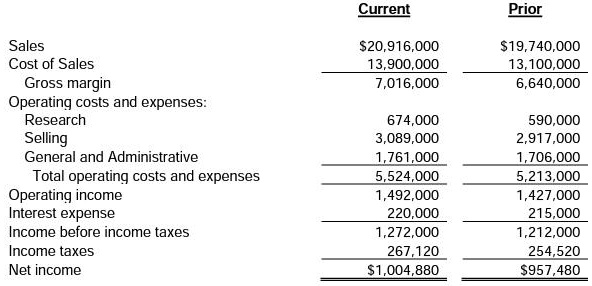
Current Prior Sales $20,916,000 $19,740,000 Cost of Sales 13,900,000 13,100,000 Gross margin 7,016,000 6,640,000 Operating costs and expenses: Research 674,000 590,000 Selling 3,089,000 2,917,000 General and Administrative 1,761,000 1,706,000 Total operating costs and expenses 5,524,000 5,213,000 Operating income 1,492,000 1,427,000 Interest expense 220,000 215,000 Income before income taxes 1,272,000 1,212,000 Income taxes 267,120 254,520 Net income $1,004,880 $957,480
View Answer
divider
BEST MATCH

Initially, AmeriTech is the only producer of specialized control modules for equipment used by refineries for distilling the base mixture for latex paint. Suppose AmeriTech faces a linear market demand curve for its services: $Q = 456 - 0.25P$ where P is price in dollars of a control module and Q is the number of modules produced per month. AmeriTech has the following variable costs per month: (you may assume there are no fixed costs for simplicity) $TVC_A = 2Q_A^2$ a. Given that AmeriTech is the only supplier in this market, determine the price AmeriTech will charge, the quantity of modules sold each month, and the profits earned assuming AmeriTech's objective is profit maximization. Now suppose the situation changes and Brighton Boards decides to enter the market. Being new to the market, Brighton Boards's costs are different from AmeriTech's, Brighton Boards has monthly variable costs: (again, you may assume there are no fixed costs for simplicity) $TVC_B = 3Q_B^2$ b. If AmeriTech uses its first-mover advantage so that the market can be characterized as a Stackelberg duopoly, how many standardized control modules will each firm sell per month? (Note: From this point forward, you may round all your results, both intermediate and final to 2 decimal places to simplify the calculations.) c. What will be the total number modules sold and what will be the market price for a module? d. Compare the market outcomes under monopoly conditions to those with two competitors. Specifically, how does price and output (of modules) compare after the entry by Brighton Boards? e. How much profit does each firm earn after entry? f. Suppose instead of a Stackelberg duopoly, that the Cournot model is the appropriate one. Under this scenario, how much output would each firm offer and what would be the market price for a module?

View Answer
divider