Ace - AI Tutor
Ask Our Educators
Textbooks
My Library
Flashcards
Scribe - AI Notes
Notes & Exams
Download App
jeffery thomas

jeffery t.

Divider

Questions asked

BEST MATCH

Explain how time lags in density dependence contribute to population cycles?

View Answer
divider
BEST MATCH

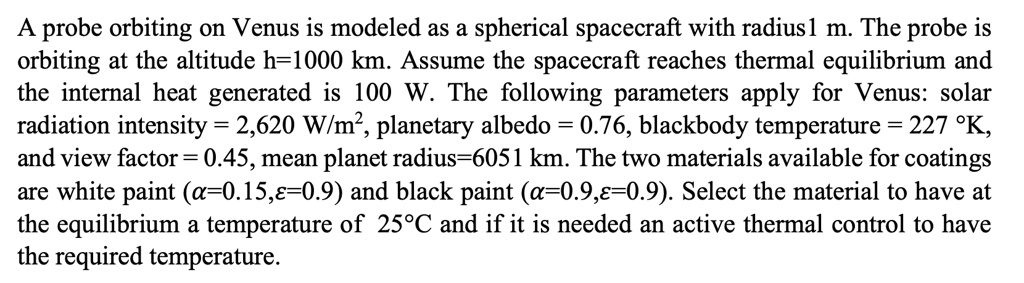
A probe orbiting on Venus is modeled as a spherical spacecraft with radius 1m. The probe is orbiting at the altitude h=1000km. Assume the spacecraft reaches thermal equilibrium and the internal heat generated is 100W. The following parameters apply for Venus: solar radiation intensity =2,620(W)/(m^(2)), planetary albedo =0.76, blackbody temperature =227deg K, and view factor =0.45, mean planet radius =6051km. The two materials available for coatings are white paint (alpha =0.15,epsi =0.9) and black paint (alpha =0.9,epsi =0.9). Select the material to have at the equilibrium a temperature of 25deg C and if it is needed an active thermal control to have the required temperature. A probe orbiting on Venus is modeled as a spherical spacecraft with radius1 m. The probe is orbiting at the altitude h=1000 km. Assume the spacecraft reaches thermal equilibrium and the internal heat generated is 100 W. The following parameters apply for Venus: solar radiation intensity = 2,620 W/m2, planetary albedo = 0.76, blackbody temperature = 227 K, and view factor = 0.45, mean planet radius=6051 km. The two materials available for coatings are white paint (a=0.15,=0.9) and black paint (a=0.9,=0.9). Select the material to have at the equilibrium a temperature of 25C and if it is needed an active thermal control to have the required temperature.
View Answer
divider
BEST MATCH

2(×5/5) on the closed interval 0 to 3 = 2/5(35) how did they get 2/5(35)? Seems like I missed some steps going straight to the answer.

View Answer
divider
BEST MATCH

4. (10 pts) Find the current $i$ and the voltage $v$ across the diode in the following circuit, assuming that the diode characteristic is shown below.

View Answer
divider
BEST MATCH

A car is traveling at a speed of 40 m/s when the brakes are suddenly applied, causing a constant deceleration of 5 $m/s^2$. Determine the distance traveled before stopping. Select one: a. 45 m b. 160 m c. 90 m d. 80 m

View Answer
divider
BEST MATCH

SECTION II: (TRUE/FALSE) CLICK TRUE OR FALSE. *************Follow fire safety guidelines to protect lives, structures, and equipment. To avoid an electrical shock and to prevent damage to the computer, turn off and plug the computer before beginning a repair. * SECTION I: FILL IN THE BLANKS: PICK EXACT TRUE ANSWER****As a best practice, make sure that a fire extinguisher and first aid kit are available in case of fire or injury. Poorly placed or unsecured cables can cause in a network installation. *

View Answer
divider
BEST MATCH

5.21. Compute the Fourier transform of each of the following signals: (a) $x[n] = u[n - 2] - u[n - 6]$ (b) $x[n] = (\frac{1}{2})^{-n}u[-n - 1]$ (c) $x[n] = (\frac{1}{3})^{|n|}u[-n - 2]$ (d) $x[n] = 2^n \sin(\frac{\pi}{4}n)u[-n]$

View Answer
divider
BEST MATCH

COST 10 9 8 7 6 5 4 3 2 1 D C B A 1 2 3 4 5 6 7 8 9 10 QUANTITY Refer to Figure 13-2. Curve A is always declining because Select one: a. marginal product first increases, then decreases. b. marginal product first decreases, then increases. c. we are dividing fixed costs by higher and higher levels of output. d. of diminishing marginal product.

View Answer
divider
BEST MATCH

Suppose Alice publishes the following data: n = pq = 221 and e = 13. Bob receives the message P = 65 and the corresponding digital signature S = 182. How can you verify the signature?

View Answer
divider
BEST MATCH

Asset Expected Return A 10% B 4% Suppose the risk free rate is 2% and the market risk premium is 5%. Problem 1a. What is the beta of asset A? (Assume $\alpha_A = 0$). Problem 1b. What is the beta of asset B? (Assume $\alpha_B = 0$). Problem 1c. Suppose we introduced a new asset, asset C.Let's assume that the prediction of CAPM that $\alpha_C = 0$ does not hold. Asset C has a beta of $\beta_C = 1.0$ and E($r_C$) = 12%. What is the alpha on C? Problem 1d. Consider a portfolio: 10% $r_f$, 20% A, 30% B, 40% C. What is the $\alpha$ on this portfolio? What is the $\beta$? What is the expected return?

View Answer
divider