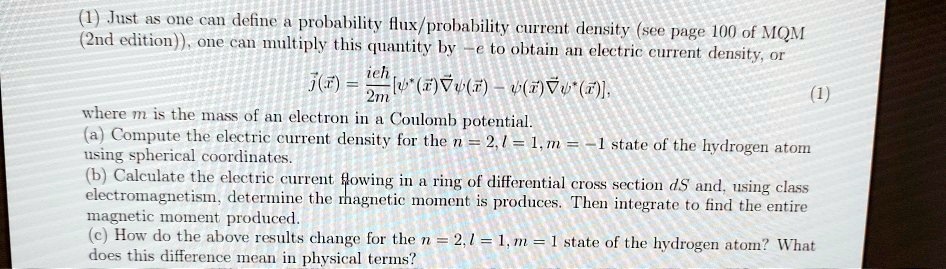
(1) Just as one can define a probability flux/probability current density (see page 100 of MQM
(2nd edition)), one can multiply this quantity by $-e$ to obtain an electric current density, or
\begin{equation}
\vec{j}(\vec{x}) = \frac{ieh}{2m}[\psi^*(\vec{x})\nabla\psi(\vec{x}) - \psi(\vec{x})\nabla\psi^*(\vec{x})],
\end{equation}
where $m$ is the mass of an electron in a Coulomb potential.
(a) Compute the electric current density for the $n = 2, l = 1, m = -1$ state of the hydrogen atom
using spherical coordinates.
(b) Calculate the electric current flowing in a ring of differential cross section $dS$ and, using class
electromagnetism, determine the magnetic moment is produces. Then integrate to find the entire
magnetic moment produced.
(c) How do the above results change for the $n = 2, l = 1, m = 1$ state of the hydrogen atom? What
does this difference mean in physical terms?