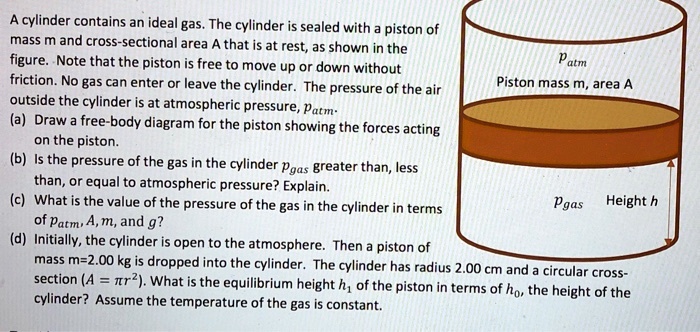
A cylinder contains an ideal gas. The cylinder is sealed with a piston of mass m and cross-sectional area A that is at rest, as shown in the figure. Note that the piston is free to move up or down without friction. No gas can enter or leave the cylinder. The pressure of the air outside the cylinder is at atmospheric pressure, $p_{atm}$.
(a) Draw a free-body diagram for the piston showing the forces acting on the piston.
(b) Is the pressure of the gas in the cylinder $p_{gas}$ greater than, less than, or equal to atmospheric pressure? Explain.
(c) What is the value of the pressure of the gas in the cylinder in terms of $p_{atm}$, A, m, and g?
(d) Initially, the cylinder is open to the atmosphere. Then a piston of mass m=2.00 kg is dropped into the cylinder. The cylinder has radius 2.00 cm and a circular cross-section ($A = \pi r^2$). What is the equilibrium height $h_1$ of the piston in terms of $h_0$, the height of the cylinder? Assume the temperature of the gas is constant.