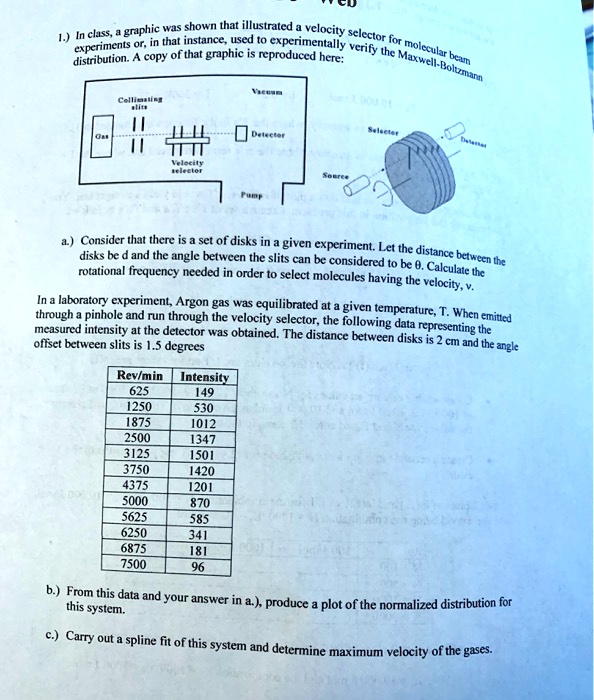
1.) In class, a graphic was shown that illustrated a velocity selector for molecular beam experiments or, in that instance, used to experimentally verify the Maxwell-Boltzmann distribution. A copy of that graphic is reproduced here:
Gas
Collimating
slits
Vacuum
Detector
Velocity
selector
Source
Pump
900.01
Selector
Deterkar
a.) Consider that there is a set of disks in a given experiment. Let the distance between the disks be $d$ and the angle between the slits can be considered to be $\theta$. Calculate the rotational frequency needed in order to select molecules having the velocity, $v$.
In a laboratory experiment, Argon gas was equilibrated at a given temperature, T. When emitted through a pinhole and run through the velocity selector, the following data representing the measured intensity at the detector was obtained. The distance between disks is 2 cm and the angle offset between slits is 1.5 degrees
Rev/min Intensity
625
149
1250
530
1875
1012
2500
1347
3125
1501
3750
1420
4375
1201
5000
870
5625
585
6250
341
6875
181
7500
96
b.) From this data and your answer in a.), produce a plot of the normalized distribution for this system.
c.) Carry out a spline fit of this system and determine maximum velocity of the gases.