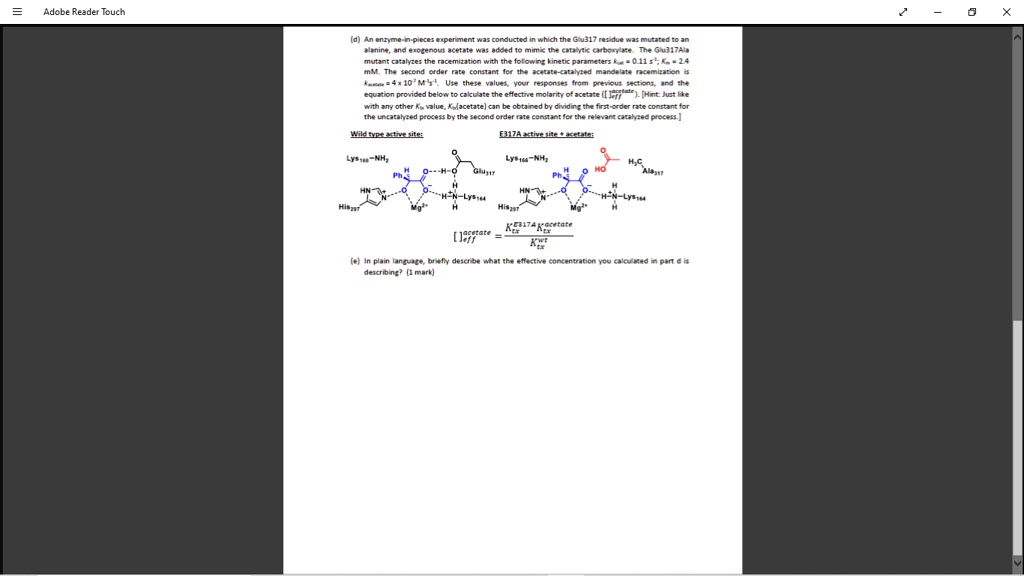
(d) An enzyme-in-pieces experiment was conducted in which the Glu317 residue was mutated to an alanine, and exogenous acetate was added to mimic the catalytic carboxylate. The Glu317Ala mutant catalyzes the racemization with the following kinetic parameters: $k_{cat} = 0.11 s^{-1}$; $K_M = 2.4$ mM. The second order rate constant for the acetate-catalyzed mandelate racemization is $k_{cat} = 4 imes 10^4 M^{-1}s^{-1}$. Use these values, your responses from previous sections, and the equation provided below to calculate the effective molarity of acetate ([acetate]). [Hint: Just like with any other $K$ value, $K_{cat}$(acetate) can be obtained by dividing the first-order rate constant for the uncatalyzed process by the second order rate constant for the relevant catalyzed process.]
Wild type active site:
Lys166-$NH_2$
E317A active site + acetate:
Lys166-$NH_2$
$[{acetate}] = \frac{k_{E317A} k_{acetate}}{k_{WT}}$
(e) In plain language, briefly describe what the effective concentration you calculated in part d is describing? (1 mark)