Question 2
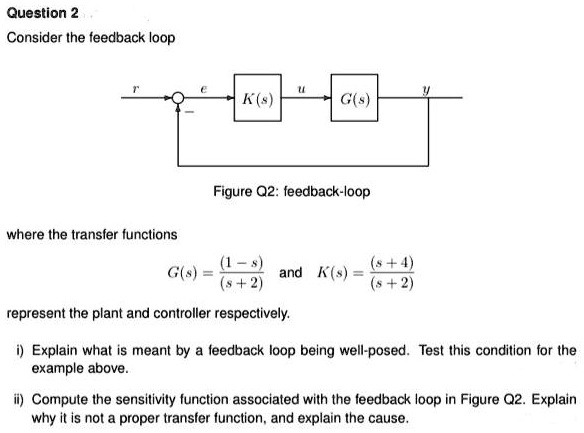
Consider the feedback loop
\begin{figure}[h]
\centering
\begin{tikzpicture}[auto, node distance=2cm]
\node [input, name=r] {};
\node [sum, right of=r] (sum) {};
\node [block, right of=sum] (k) {$K(s)$};
\node [block, right of=k] (g) {$G(s)$};
\node [output, right of=g] (y) {};
\draw [->] (r) -- node {$r$} (sum);
\draw [->] (sum) -- node {$e$} (k);
\draw [->] (k) -- node {$u$} (g);
\draw [->] (g) -- node {$y$} (y);
\draw [->] (y) |- (sum);
\draw [-] (sum) -- ++(0,-0.5) -- ++(-2,0) -- ++(0,0.5);
\node at (-0.5,-0.5) {$-$};
\end{tikzpicture}
\caption{Figure Q2: feedback-loop}
\end{figure}
where the transfer functions
$G(s) = \frac{(1-s)}{(s+2)}$ and $K(s) = \frac{(s+4)}{(s+2)}$
represent the plant and controller respectively.
i) Explain what is meant by a feedback loop being well-posed. Test this condition for the
example above.
ii) Compute the sensitivity function associated with the feedback loop in Figure Q2. Explain
why it is not a proper transfer function, and explain the cause.