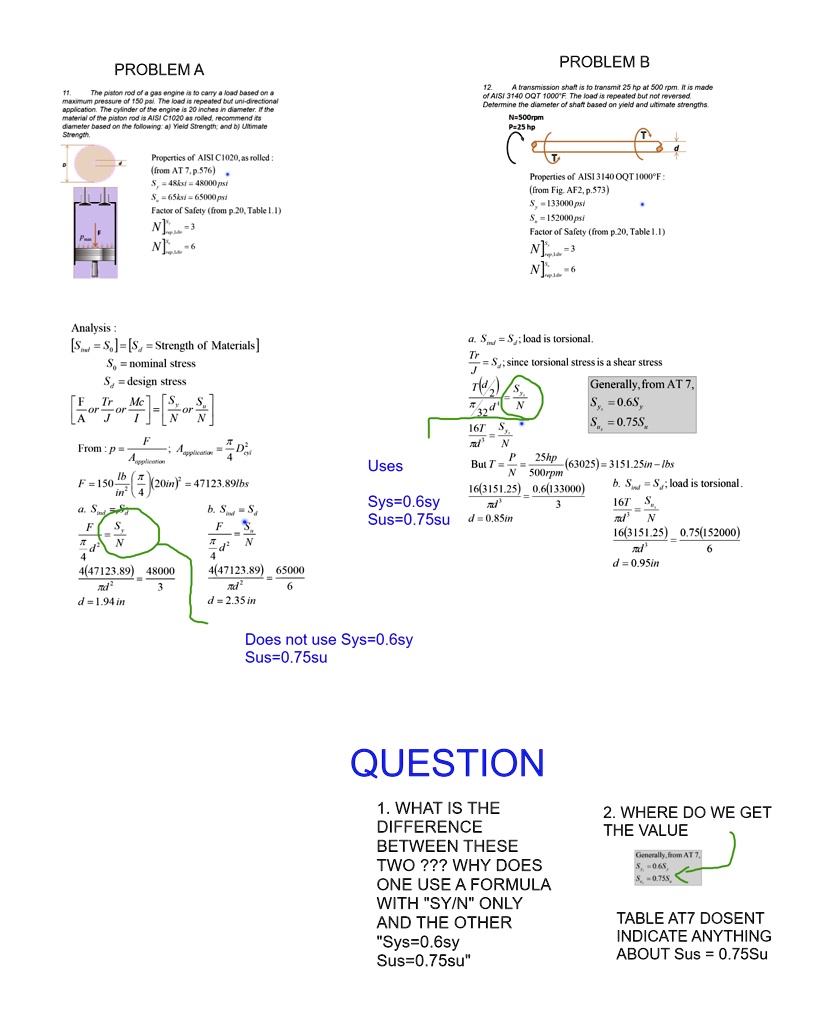
Texts: Not so much of a solution. More on explanation and logic and simply reading the table.
PROBLEM A
A transmission shaft is to transmit 25 hp at 500 rpm. If it is made of AISI 3140 OQT 1000°F. The load is repeated but not reversed. Determine the diameter of the shaft based on yield and ultimate strengths. N = 500 rpm.
Properties of AISI C1020, as rolled (from AT 7, p.576):
S_y = 48 ksi = 48000 psi
S_u = 65 ksi = 65000 psi
Factor of Safety (from p.20, Table 1.1): N = 3
Properties of AISI 3140 OQT 1000°F (from Fig. AF2, p.573):
S_y = 133000 psi
S_u = 152000 psi
Factor of Safety (from p.20, Table 1.1): N = 6
Analysis: [S=S]=[S= Strength of Materials]
S_y = nominal stress
S_d = design stress
S_r = S_y ; load is torsional.
Generally, from AT 7, S_d = 0.6S_y, S_a = 0.75S_u
A:
N = 16T/(5,000d)
But T = P
Uses N = 500 rpm
16(25)/(5,000d) = 0.6(133000)
S_d = 0.6S_y
S_a = 0.75S_u
d = 0.85 in
B:
S_d = S_y ; load is torsional.
16T/(5,000d) = 0.75(152000)
d = 0.95 in
B:
S_d = S_y
4(47123.89)/(48000d^2) = 3
d = 1.94 in
B:
S_d = S_y
4(47123.89)/(65000d^2) = 6
d = 2.35 in
Does not use S_d = 0.6S_y, S_a = 0.75S_u
QUESTION
1. WHAT IS THE DIFFERENCE BETWEEN THESE TWO? WHY DOES ONE USE A FORMULA WITH "S_d = S_y/N" ONLY AND THE OTHER "S_d = 0.6S_y, S_a = 0.75S_u"?
2. WHERE DO WE GET THE VALUE?
Generally, from AT 7, S_d = 0.6S_y, S_a = 0.75S_u.
The table AT7 doesn't indicate anything about S_a = 0.75S_u.