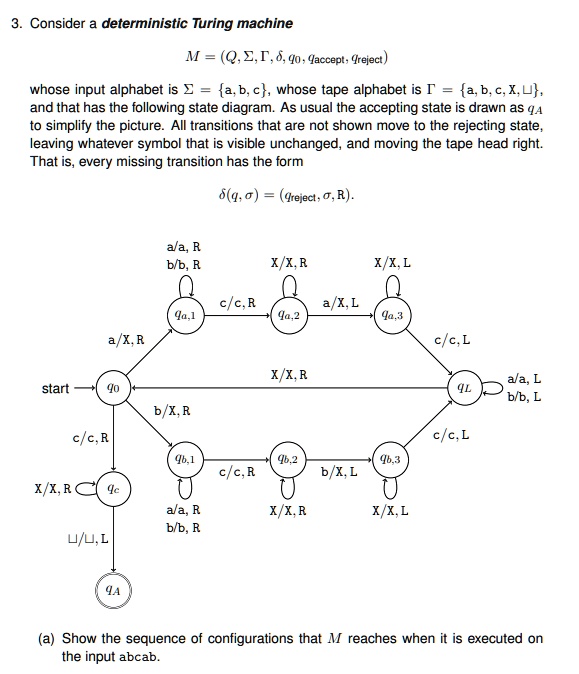
3. Consider a deterministic Turing machine
? = (Q, ?, ?, ?, q?, q_{accept}, q_{reject})
whose input alphabet is ? = {a, b, c}, whose tape alphabet is ? = {a, b, c, X, U},
and that has the following state diagram. As usual the accepting state is drawn as q<sub>A</sub>
to simplify the picture. All transitions that are not shown move to the rejecting state,
leaving whatever symbol that is visible unchanged, and moving the tape head right.
That is, every missing transition has the form
?(q, ?) = (q_{reject}, ?, R).
a/a, R
b/b, R
X/X, R
X/X, L
c/c, R
a/X, L
q_{a,1}
q_{a,2}
q_{a,3}
a/X, R
c/c, L
X/X, R
start
q?
q<sub>L</sub>
a/a, L
b/b, L
b/X, R
c/c, R
c/c, L
q_{b,1}
q_{b,2}
q_{b,3}
c/c, R
b/X, L
X/X, R
q<sub>c</sub>
a/a, R
X/X, R
X/X, L
b/b, R
U/U, L
q<sub>A</sub>
(a) Show the sequence of configurations that M reaches when it is executed on
the input abcab.