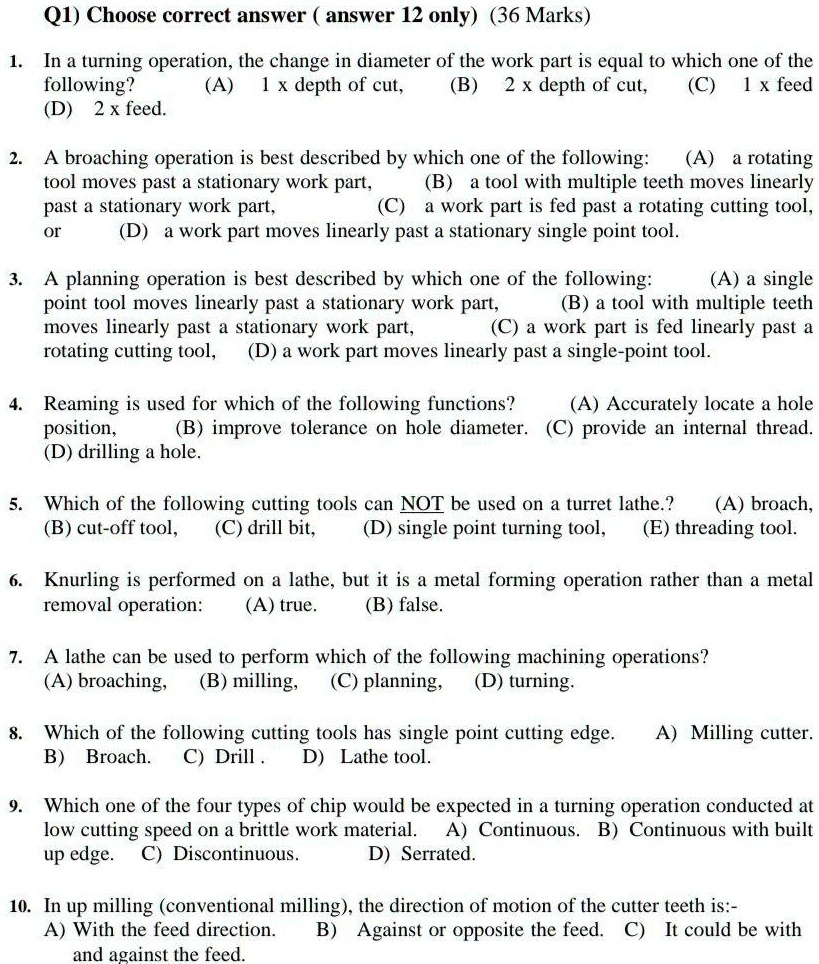
1. In a turning operation, the change in diameter of the work part is equal to which one of the following? A) 1 x depth of cut, B) 2 x depth of cut, C) 1 x feed, D) 2 x feed.
2. A broaching operation is best described by which one of the following: A) a rotating tool moves past a stationary work part, B) a tool with multiple teeth moves linearly past a stationary work part, C) a work part is fed past a rotating cutting tool.
3. A planning operation is best described by which one of the following: A) a single point tool moves linearly past a stationary work part, B) a tool with multiple teeth moves linearly past a stationary work part, C) a work part is fed linearly past a rotating cutting tool, D) a work part moves linearly past a single-point tool.
4. Reaming is used for which of the following functions: A) accurately locate a hole position, B) improve tolerance on hole diameter, C) provide an internal thread, D) drilling a hole.
5. Which of the following cutting tools can NOT be used on a turret lathe? A) broach, B) cut-off tool, C) drill bit, D) single point turning tool, E) threading tool.
6. Knurling is performed on a lathe, but it is a metal forming operation rather than a metal removal operation: A) true, B) false.
7. A lathe can be used to perform which of the following machining operations? A) broaching, B) milling, C) planning, D) turning.
8. Which of the following cutting tools has a single point cutting edge? A) broach, B) drill, C) lathe tool, D) milling cutter.
9. Which one of the four types of chip would be expected in a turning operation conducted at low cutting speed on a brittle work material? A) Continuous, B) Continuous with built up edge, C) Discontinuous, D) Serrated.
10. In up milling (conventional milling), the direction of motion of the cutter teeth is: A) With the feed direction, B) Against or opposite the feed, C) It could be with and against the feed.