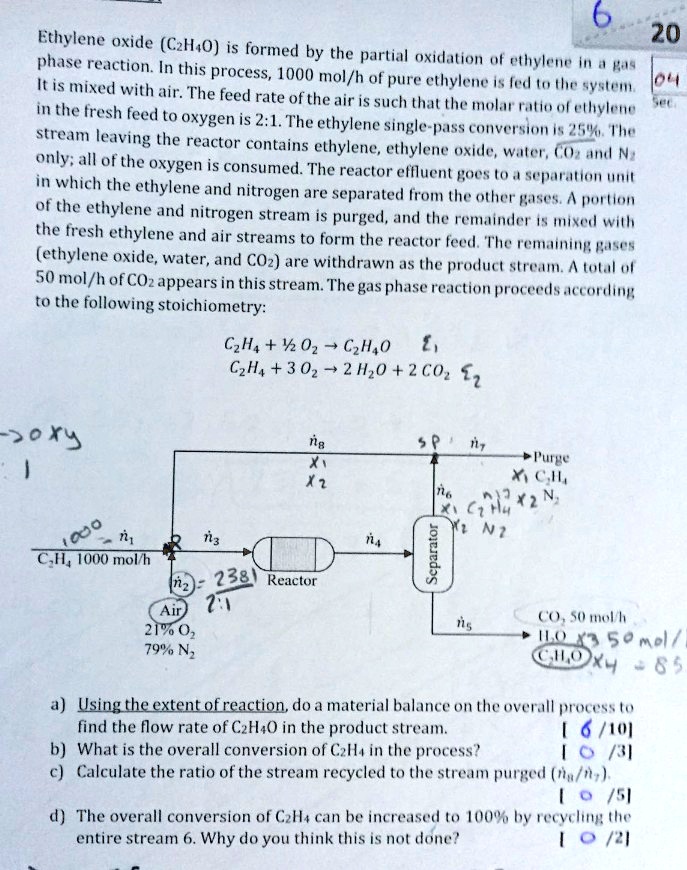
Ethylene oxide (C$_2$H$_4$O) is formed by the partial oxidation of ethylene in a gas phase reaction. In this process, 1000 mol/h of pure ethylene is fed to the system. It is mixed with air. The feed rate of the air is such that the molar ratio of ethylene in the fresh feed to oxygen is 2:1. The ethylene single-pass conversion is 25%. The stream leaving the reactor contains ethylene, ethylene oxide, water, CO$_2$ and N$_2$ only; all of the oxygen is consumed. The reactor effluent goes to a separation unit in which the ethylene and nitrogen are separated from the other gases. A portion of the ethylene and nitrogen stream is purged, and the remainder is mixed with the fresh ethylene and air streams to form the reactor feed. The remaining gases (ethylene oxide, water, and CO$_2$) are withdrawn as the product stream. A total of 50 mol/h of CO$_2$ appears in this stream. The gas phase reaction proceeds according to the following stoichiometry:
C$_2$H$_4$ + \frac{1}{2}O$_2$ $\rightarrow$ C$_2$H$_4$O $\qquad \Sigma_1$
C$_2$H$_4$ + 3O$_2$ $\rightarrow$ 2H$_2$O + 2CO$_2$ $\qquad \Sigma_2$
a) Using the extent of reaction, do a material balance on the overall process to find the flow rate of C$_2$H$_4$O in the product stream.
b) What is the overall conversion of C$_2$H$_4$ in the process?
c) Calculate the ratio of the stream recycled to the stream purged ($n_8$/$n_7$).
d) The overall conversion of C$_2$H$_4$ can be increased to 100% by recycling the entire stream 6. Why do you think this is not done?