3.
(a) Explain briefly the 3 main multiplexing techniques used in mobile
communication systems, Frequency Division Multiplexing (FDMA), Time
Division Multiplexing (TDMA) and Code Division Multiplexing (CDMA).
[4]
(b)
A number of Mobile Communication Systems use Orthogonal Frequency
Division Multiplexing (OFDM) to provide higher communication rates,
explain why ODFM is less affected by fading and so supports higher data
[6]
rates.
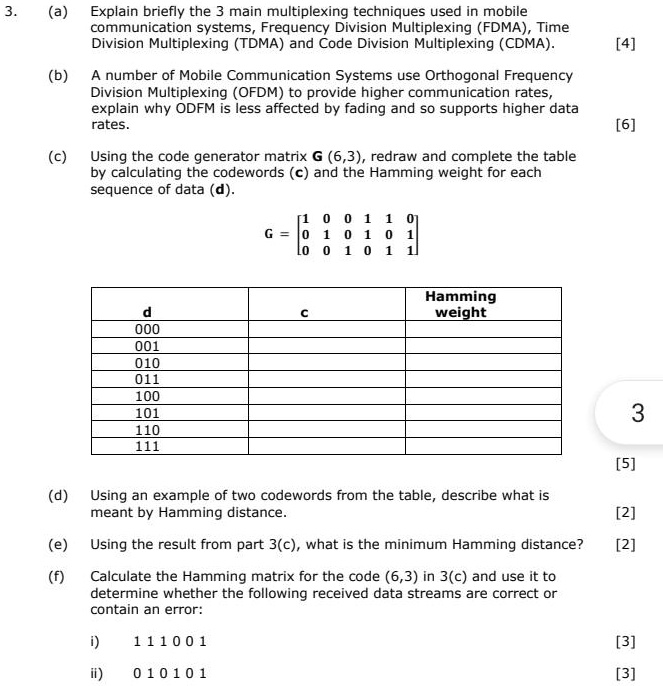
(c) Using the code generator matrix G (6,3), redraw and complete the table
by calculating the codewords (c) and the Hamming weight for each
sequence of data (d).
$\begin{bmatrix} 1 & 0 & 0 & 1 & 1 & 0\\ 0 & 1 & 0 & 1 & 0 & 1\\ 0 & 0 & 1 & 0 & 1 & 1 \end{bmatrix}$
G =
\begin{tabular}{|c|c|c|}
\hline
d & c & Hamming\\& & weight\\\hline
000 & & \\
001 & & \\
010 & & \\
011 & & \\
100 & & \\
101 & & \\
110 & & \\
111 & & \\
\hline
\end{tabular}
3
[5]
(d) Using an example of two codewords from the table, describe what is
meant by Hamming distance.
[2]
(e) Using the result from part 3(c), what is the minimum Hamming distance?
[2]
(f) Calculate the Hamming matrix for the code (6,3) in 3(c) and use it to
determine whether the following received data streams are correct or
contain an error:
i) 111001
[3]
ii) 010101
[3]