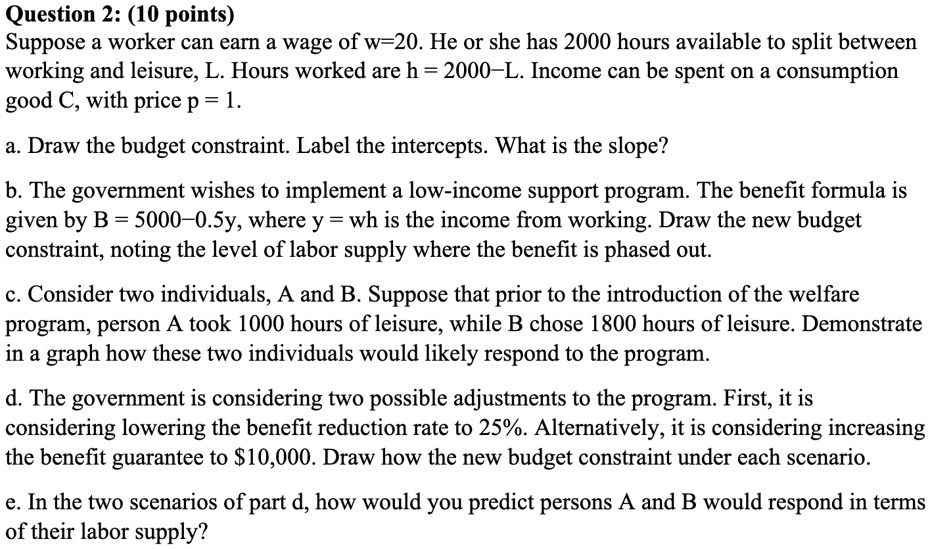
Question 2: (10 points)
Suppose a worker can earn a wage of w=20. He or she has 2000 hours available to split between
working and leisure, L. Hours worked are h = 2000-L. Income can be spent on a consumption
good C, with price p = 1.
a. Draw the budget constraint. Label the intercepts. What is the slope?
b. The government wishes to implement a low-income support program. The benefit formula is
given by B = 5000-0.5y, where y = wh is the income from working. Draw the new budget
constraint, noting the level of labor supply where the benefit is phased out.
c. Consider two individuals, A and B. Suppose that prior to the introduction of the welfare
program, person A took 1000 hours of leisure, while B chose 1800 hours of leisure. Demonstrate
in a graph how these two individuals would likely respond to the program.
d. The government is considering two possible adjustments to the program. First, it is
considering lowering the benefit reduction rate to 25%. Alternatively, it is considering increasing
the benefit guarantee to $10,000. Draw how the new budget constraint under each scenario.
e. In the two scenarios of part d, how would you predict persons A and B would respond in terms
of their labor supply?