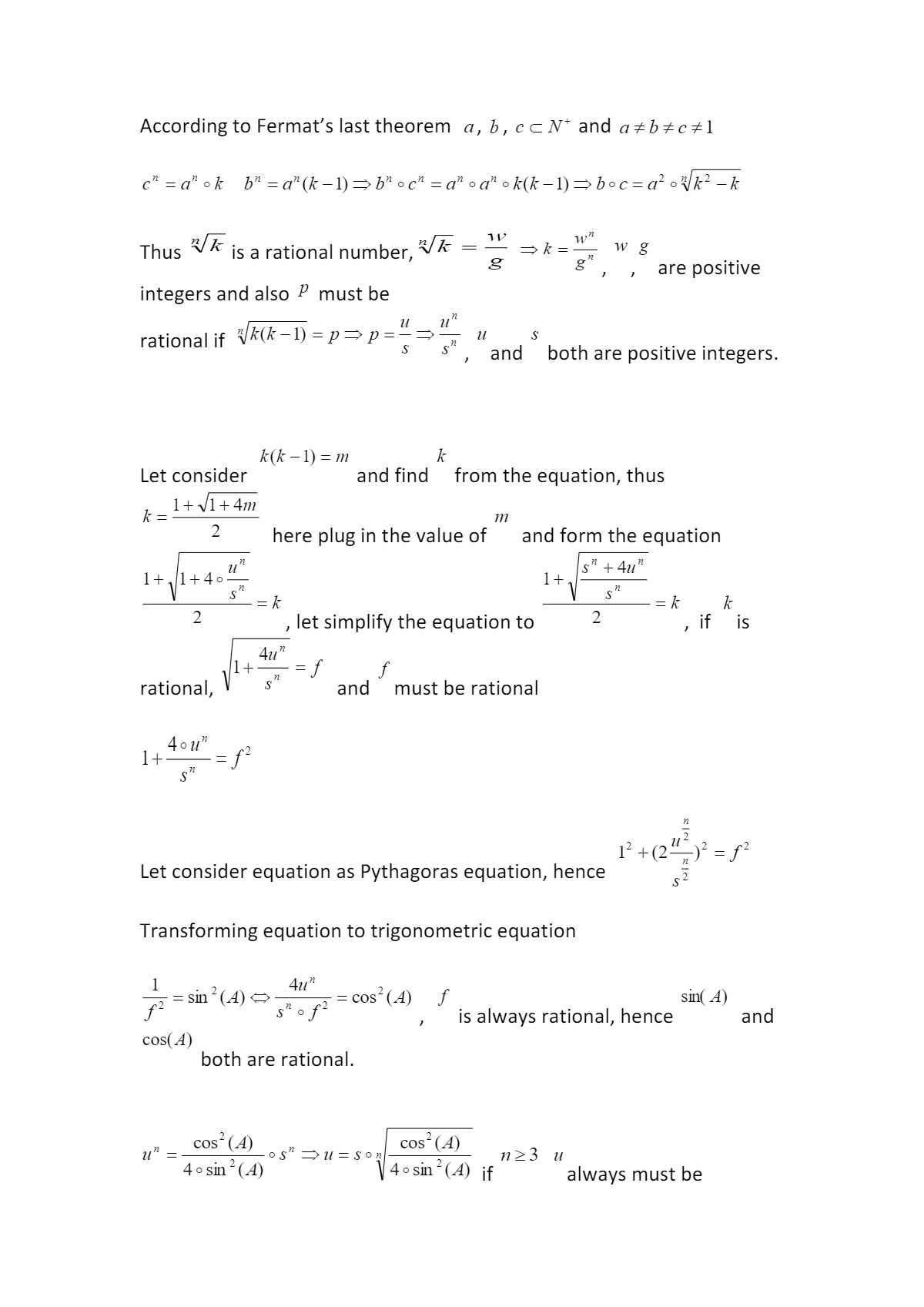
According to Fermat's last theorem \( a, b, c \subset N^{+} \)and \( a \neq b \neq c \neq 1 \)
\[
c^{n}=a^{n} \circ k \quad b^{n}=a^{n}(k-1) \Rightarrow b^{n} \circ c^{n}=a^{n} \circ a^{n} \circ k(k-1) \Rightarrow b \circ c=a^{2} \circ \sqrt[n]{k^{2}-k}
\]
Thus \( \sqrt[n]{k} \) is a rational number, \( \sqrt[n]{k}=\frac{w}{g} \Rightarrow k=\frac{w^{n}}{g^{n}}, w \quad, \quad \) are positive integers and also \( { }^{p} \) must be
rational if \( \sqrt[n]{k(k-1)}=p \Rightarrow p=\frac{u}{s} \Rightarrow \frac{u^{n}}{s^{n}}, u \) and both are positive integers.
Let consider \( { }^{k(k-1)=m} \) and find \( { }^{k} \) from the equation, thus \( k=\frac{1+\sqrt{1+4 m}}{2} \) here plug in the value of \( { }^{m} \) and form the equation \( \frac{1+\sqrt{1+40 \frac{u^{n}}{s^{n}}}}{2}=k \) , let simplify the equation to \( \frac{1+\sqrt{\frac{s^{n}+4 u^{n}}{s^{n}}}}{2}=k \), if is rational, \( \sqrt{1+\frac{4 u^{n}}{s^{n}}}=f \) and \( f \) must be rational
\[
1+\frac{4 \circ u^{n}}{s^{n}}=f^{2}
\]
Let consider equation as Pythagoras equation, hence \( 1^{2}+\left(2 \frac{u^{\frac{n}{2}}}{s^{\frac{n}{2}}}\right)^{2}=f^{2} \)
Transforming equation to trigonometric equation
\( \frac{1}{f^{2}}=\sin ^{2}(A) \Leftrightarrow \frac{4 u^{n}}{s^{n} \circ f^{2}}=\cos ^{2}(A), \quad \) is always rational, hence \( \sin (A) \) and \( \cos (A) \) both are rational.
\[
u^{n}=\frac{\cos ^{2}(A)}{4 \circ \sin ^{2}(A)} \circ s^{n} \Rightarrow u=s \circ \sqrt[n]{\frac{\cos ^{2}(A)}{4 \circ \sin ^{2}(A)}} \text { if } n \geq 3 \quad u \text { always must be }
\]