Ace - AI Tutor
Ask Our Educators
Textbooks
My Library
Flashcards
Scribe - AI Notes
Notes & Exams
Download App
jennifer anderson

jennifer a.

Divider

Questions asked

BEST MATCH

Solve the equation: $z^2 + 11z = 0$ Answer: $z = $ Write your answers as a list of integers or reduced fractions, with your answers separated by (a) comma(s). For example, if you get 4 and $-\frac{2}{3}$ as your answers, then enter $4, -2/3$ in the box.

View Answer
divider
BEST MATCH

Exogenous administration of oxytocin-like drugs (ie. pitocin) can induce labor any time during pregnancy. Group of answer choices True False

View Answer
divider
BEST MATCH

This substance is typically single stranded. Question 23 options: RNA neither both DNA

View Answer
divider
BEST MATCH

Extended family is important because it provides a sense of identity and kinship to individuals. True or false?

View Answer
divider
BEST MATCH

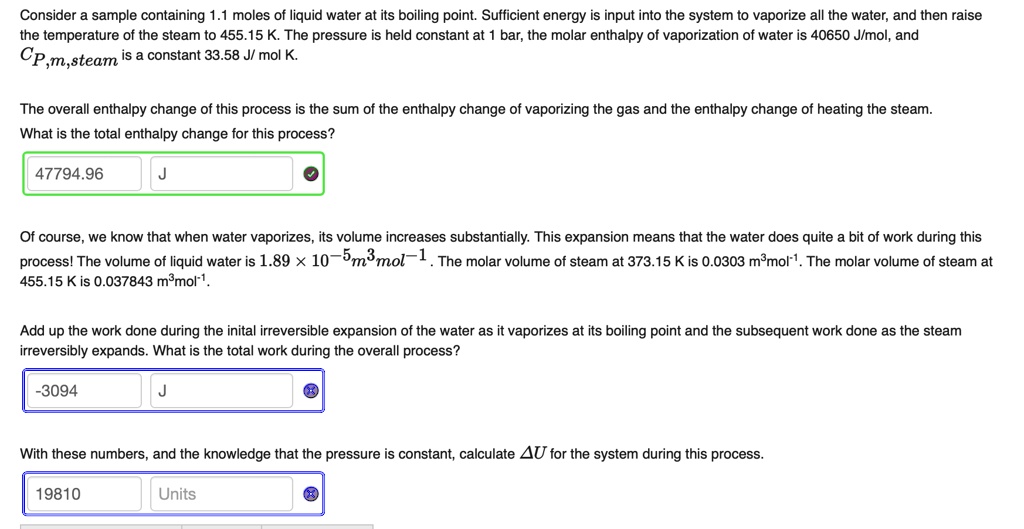
Consider a sample containing 1.1 moles of liquid water at its boiling point. Sufficient energy is input into the system to vaporize all the water, and then raise the temperature of the steam to 455.15K. The pressure is held constant at 1 bar, the molar enthalpy of vaporization of water is 40650(J)/(m)ol, and C_(P,m,steam) is a constant 33.58(J)/(m)olK. The overall enthalpy change of this process is the sum of the enthalpy change of vaporizing the gas and the enthalpy change of heating the steam. What is the total enthalpy change for this process? Of course, we know that when water vaporizes, its volume increases substantially. This expansion means that the water does quite a bit of work during this process! The volume of liquid water is 1.89 imes 10^(-5)m^(3)mol-1. The molar volume of steam at 373.15K is 0.0303m^(3)mol^(-1). The molar volume of steam at 455.15K is 0.037843m^(3)mol^(-1). Add up the work done during the inital irreversible expansion of the water as it vaporizes at its boiling point and the subsequent work done as the steam irreversibly expands. What is the total work during the overall process? With these numbers, and the knowledge that the pressure is constant, calculate Delta U for the system during this process. Consider a sample containing 1.1 moles of liquid water at its boiling point. Sufficient energy is input into the system to vaporize all the water, and then raise the temperature of the steam to 455.15 K.The pressure is held constant at 1 bar, the molar enthalpy of vaporization of water is 40650 J/mol, and The overall enthalpy change of this process is the sum of the enthalpy change of vaporizing the gas and the enthalpy change of heating the steam What is the total enthalpy change for this process? 47794.96 Of course, we know that when water vaporizes, its volume increases substantially. This expansion means that the water does quite a bit of work during this 455.15 K is 0.037843 m3mol-1. Add up the work done during the inital irreversible expansion of the water as it vaporizes at its boiling point and the subsequent work done as the steam irreversibly expands.What is the total work during the overall process? -3094 With these numbers, and the knowledge that the pressure is constant, calculate U for the system during this process. 19810 Units
View Answer
divider
BEST MATCH

Determine I_(ab) Determine I. Determine Iab| R3 R10 R4 2A R2 g is the reference voltage: Determine I. 10V 3A T 1092 200 1092

View Answer
divider
BEST MATCH

a) \(\ce{C=C(C)C=C} + HBr \xrightarrow{0^\circ C} \) b) \(\ce{C=C(C)C=C} + HCl \xrightarrow{100^\circ C} \)

View Answer
divider
BEST MATCH

Select all of the following functions for which the extreme value theorem guarantees the existence of an absolute maximum and minimum. Select all that apply: $f(x) = \sin(\frac{\pi x}{2})$ over $[-1, 1]$ $g(x) = \frac{1}{\sin(\frac{\pi x}{2})}$ over $[\frac{1}{2}, \frac{3}{2}]$ $h(x) = \cos(\frac{\pi x}{2})$ over $[-1, 1]$ $k(x) = \frac{1}{\cos(\frac{\pi x}{2})}$ over $[\frac{1}{2}, \frac{3}{2}]$ None of the above.

View Answer
divider
BEST MATCH

An airline chart shows that the temperature T at an altitude of h = 15,000 feet is T = 5°F. At an altitude of h = 20,000 feet, T = -15°F. Supposing that T is a linear function of h, obtain an equation that defines this function. Sketch its graph and find the temperature at an altitude h = 30,000 feet.

View Answer
divider
BEST MATCH

2. [30 points] Implement a class Car with the following properties. A car has a certain fuel efficiency (measured in mile/gallon) and a certain amount of fuel in the gas tank (measured in gallons). The efficiency is specified in the constructor, and the initial fuel level is set to 0 by default. (a) [10 points] Implement the constructor with two parameters. (b) [5 points] Implement member function add_gas(double x) that increment data member fuel. (c) [10 points] Implement member function drive(double y) that reduces the data member fuel. (d) [5 points] Implement member function get_gas_level() to return the current fuel level. #ifndef CAR_H #define CAR_H class Car { public: //constructor Car(double mpg = 28, double f = 0); void add_gas(double x); //add x gallon of fuel into the gas tank //compute the amount of gas needed to drive y miles, and reduce that amount from the existing fuel amount //Assuming there is sufficient fuel to drive y miles void drive(double y); //return the current fuel level double get_gas_level() const; private: double MPG; //miles per gallon double fuel; //amount of fuel in the gas tank }; #endif

View Answer
divider