a.
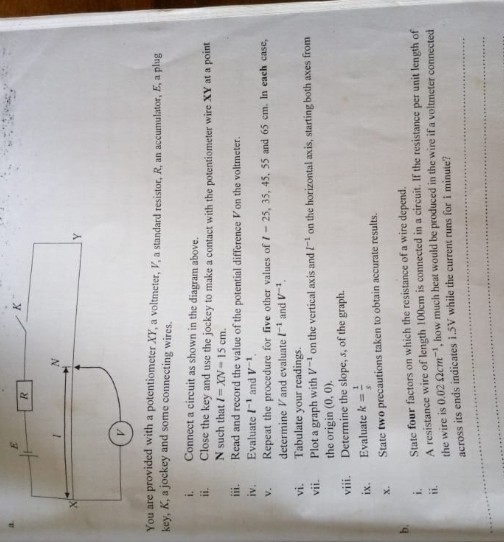
You are provided with a potentiometer \( X Y \), a voltmeter, \( V \), a standard resistor, \( R \), an accumulator, \( E \), a plug key, \( K \), a jockey and some connecting wires.
i. Connect a circuit as shown in the diagram above.
ii. Close the key and use the jockey to make a contact with the potentiometer wire XY at a point N such that \( I=X N=15 \mathrm{~cm} \).
iii. Read and record the value of the potential difference \( V \) on the voltmeter.
iv. Evaluate \( \boldsymbol{l}^{-1} \) and \( \boldsymbol{V}^{-1} \).
v. Repeat the procedure for five other values of \( I-25,35,45,55 \) and 65 cm . In each case, determine \( V \) and evaluate \( l^{-1} \) and \( V^{-1} \).
vi. Tabulate your readings.
vii. Plot a graph with \( V^{-1} \) on the vertical axis and \( l^{-1} \) on the horizontal axis, starting both axes from the origin \( (0,0) \).
viii. Determine the slope, \( s \), of the graph.
ix. Evaluate \( k=\frac{1}{3} \)
x. State two precautions taken to obtain accurate results.
b.
i. State four factors on which the resistance of a wire depend.
ii. A resistance wire of length 100 cm is connected in a circuit. If the resistance per unit length of the wire is \( 0.02 \Omega \mathrm{~cm}^{-1} \), how much heat would be produced in the wire if a voltmeter connected across its ends indicates i .5 V while the current runs for i minute?