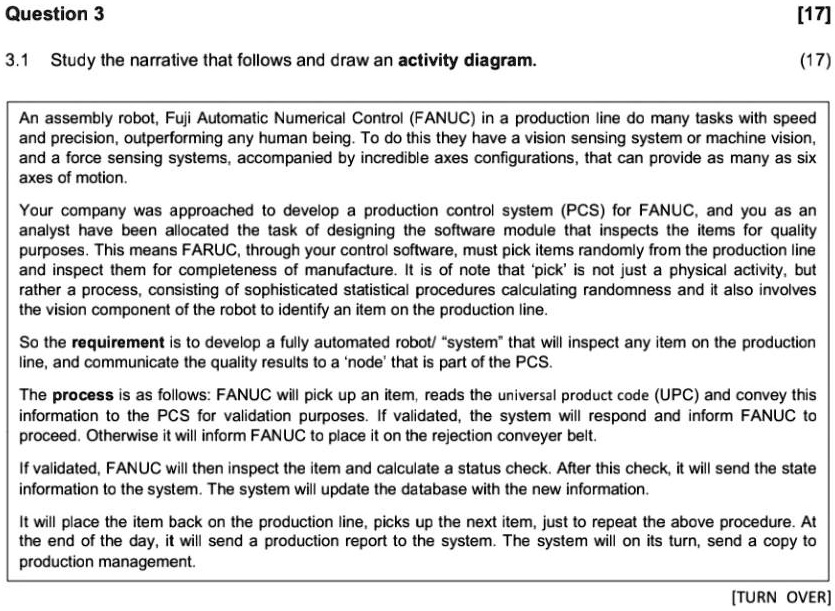
3.1 Study the narrative that follows and draw an activity diagram.
An assembly robot, Fuji Automatic Numerical Control (FANUC), in a production line does many tasks with speed and a force sensing system, accompanied by incredible axes configurations, that can provide as many as six axes of motion.
Your company was approached to develop a production control system (PCS) for FANUC, and you, as an analyst, have been allocated the task of designing the software module that inspects the items for quality purposes. This means FANUC, through your control software, must pick items randomly from the production line and inspect them for completeness of manufacture. It is of note that 'pick' is not just a physical activity, but rather a process, consisting of sophisticated statistical procedures calculating randomness, and it also involves the vision component of the robot to identify an item on the production line.
So the requirement is to develop a fully automated robot/system that will inspect any item on the production line and communicate the quality results to a 'node' that is part of the PCS.
The process is as follows: FANUC will pick up an item, read the universal product code (UPC), and convey this information to the PCS for validation purposes. If validated, the system will respond and inform FANUC to proceed. Otherwise, it will inform FANUC to place it on the rejection conveyor belt.
If validated, FANUC will then inspect the item and calculate a status check. After this check, it will send the state information to the system. The system will update the database with the new information.
It will place the item back on the production line, pick up the next item, just to repeat the above procedure.
At production management.