QCin
Qc
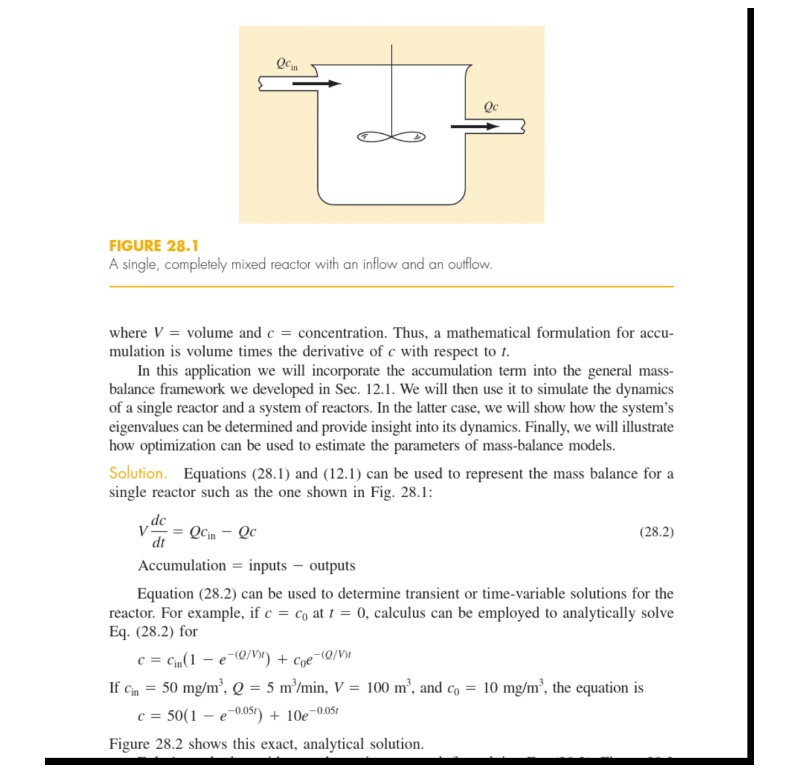
FIGURE 28.1
A single, completely mixed reactor with an inflow and an outflow.
where V = volume and c = concentration. Thus, a mathematical formulation for accu-
mulation is volume times the derivative of c with respect to t.
In this application we will incorporate the accumulation term into the general mass-
balance framework we developed in Sec. 12.1. We will then use it to simulate the dynamics
of a single reactor and a system of reactors. In the latter case, we will show how the system's
eigenvalues can be determined and provide insight into its dynamics. Finally, we will illustrate
how optimization can be used to estimate the parameters of mass-balance models.
Solution. Equations (28.1) and (12.1) can be used to represent the mass balance for a
single reactor such as the one shown in Fig. 28.1:
$\frac{dc}{dt} = Q_{cin} - Qc$
(28.2)
Accumulation = inputs - outputs
Equation (28.2) can be used to determine transient or time-variable solutions for the
reactor. For example, if c = $c_0$ at t = 0, calculus can be employed to analytically solve
Eq. (28.2) for
c = $c_{in}(1 - e^{-(Q/V)t}) + c_0e^{-(Q/V)t}$
If $c_{in}$ = 50 mg/m³, Q = 5 m³/min, V = 100 m³, and $c_0$ = 10 mg/m³, the equation is
c = 50(1 - $e^{-0.05t}$) + 10$e^{-0.05t}$
Figure 28.2 shows this exact, analytical solution.