Q3.
You are a factory manager and originally the workers are paid a fixed salary according to their skill
levels. You want to introduce a productivity-based salary in a hope to increase worker productivity.
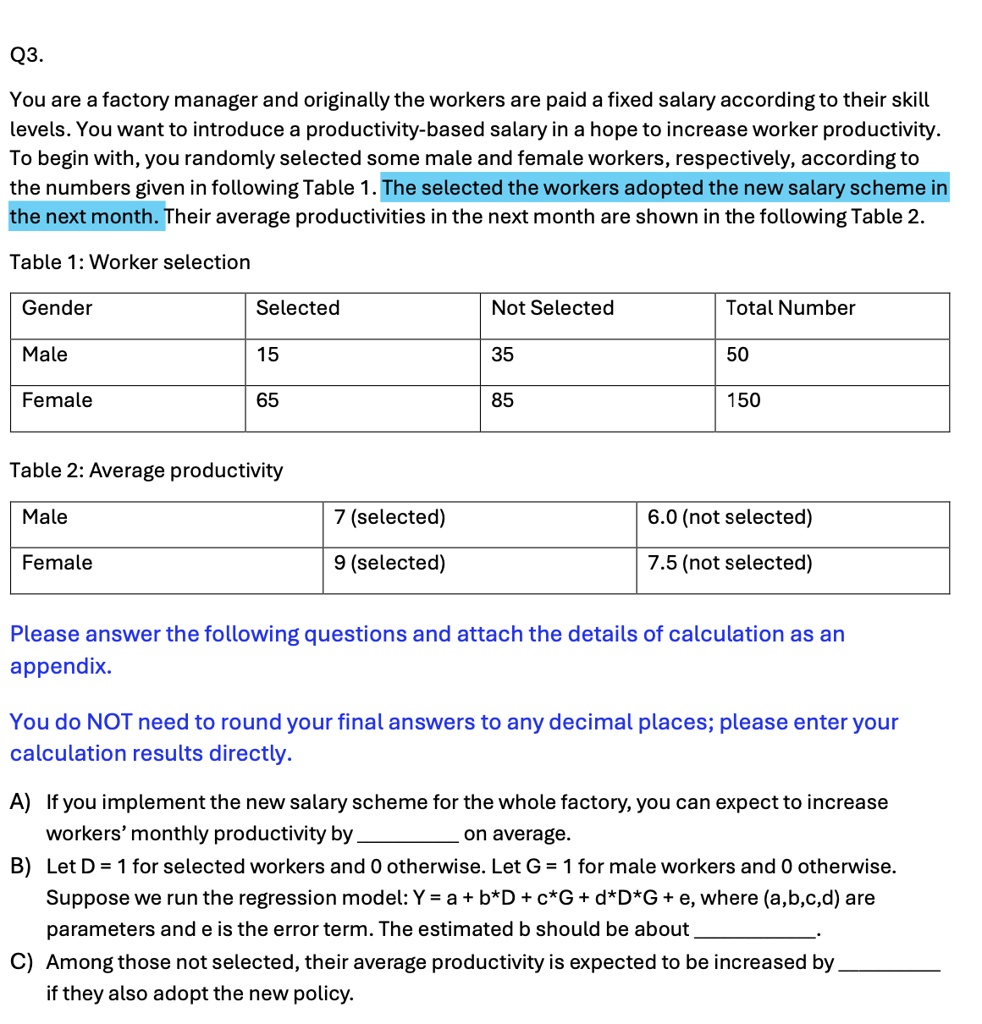
To begin with, you randomly selected some male and female workers, respectively, according to
the numbers given in following Table 1. The selected the workers adopted the new salary scheme in
the next month. Their average productivities in the next month are shown in the following Table 2.
Table 1: Worker selection
Gender
Male
Female
Selected
Not Selected
Total Number
15
35
50
65
85
150
Table 2: Average productivity
Male
Female
7 (selected)
9 (selected)
6.0 (not selected)
7.5 (not selected)
Please answer the following questions and attach the details of calculation as an
appendix.
You do NOT need to round your final answers to any decimal places; please enter your
calculation results directly.
A) If you implement the new salary scheme for the whole factory, you can expect to increase
workers' monthly productivity by
on average.
B) Let D = 1 for selected workers and 0 otherwise. Let G = 1 for male workers and 0 otherwise.
Suppose we run the regression model: Y = a + b*D + c*G + d*D*G + e, where (a,b,c,d) are
parameters and e is the error term. The estimated b should be about
C) Among those not selected, their average productivity is expected to be increased by
if they also adopt the new policy.