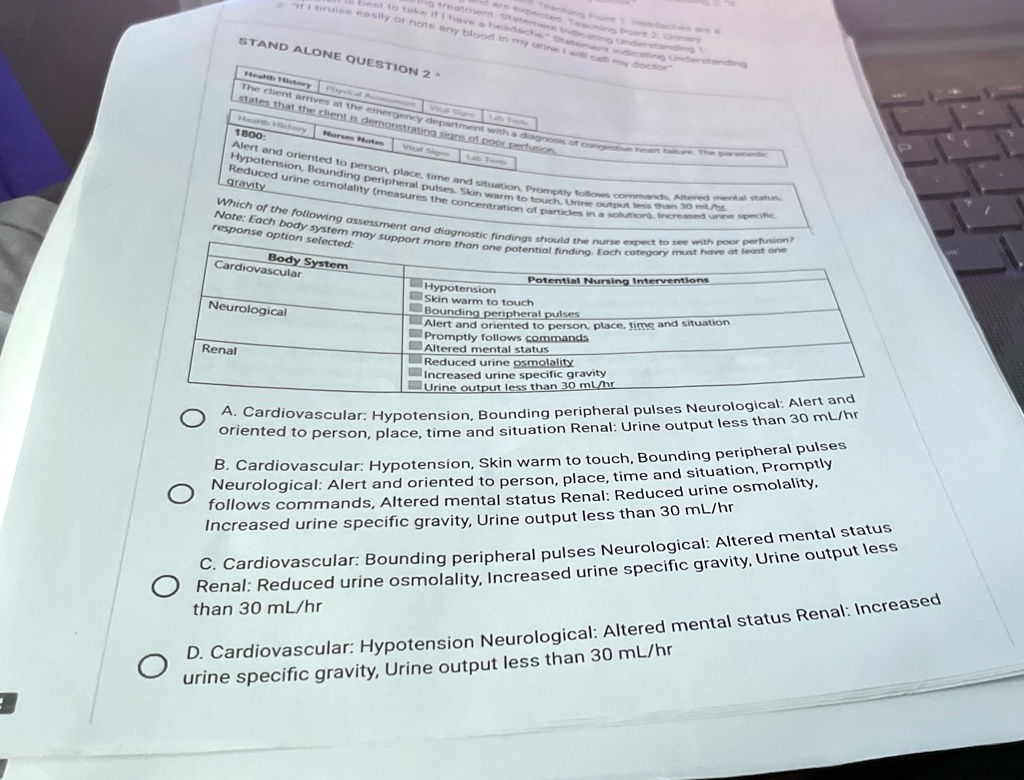
STAND ALONE QUESTION 2.
Health History Physical Assessment Vital Signs Lab Tests
The client arrives at the emergency department with a diagnosis of congestive heart failure. The paramedic
states that the client is demonstrating signs of poor perfusion.
Health History Nurses Notes Vital Signs Lab Tests
1800:
Alert and oriented to person, place, time and situation, Promptly follows commands, Altered mental status.
Hypotension, Bounding peripheral pulses and situation, Promptly follows commands, less than 30 mL/hr
Reduced urine osmolality (measures the concentration of particles in a solution), Increased urine specific
gravity
Which of the following assessment and diagnostic findings should the nurse expect to see with poor perfusion?
Note: Each body system may support more than one potential finding. Each category must have at least one
response option selected:
Body System
Cardiovascular
Neurological
Renal
Potential Nursing Interventions
Hypotension
Skin warm to touch
Bounding peripheral pulses
Alert and oriented to person, place, time and situation
Promptly follows commands
Altered mental status
Reduced urine osmolality
Increased urine specific gravity
Urine output less than 30 mL/hr
A. Cardiovascular: Hypotension, Bounding peripheral pulses Neurological: Alert and
oriented to person, place, time and situation Renal: Urine output less than 30 mL/hr
B. Cardiovascular: Hypotension, Skin warm to touch, Bounding peripheral pulses
Neurological: Alert and oriented to person, place, time and situation, Promptly
follows commands, Altered mental status Renal: Reduced urine osmolality,
Increased urine specific gravity, Urine output less than 30 mL/hr
C. Cardiovascular: Bounding peripheral pulses Neurological: Altered mental status
Renal: Reduced urine osmolality, Increased urine specific gravity, Urine output less
than 30 mL/hr
D. Cardiovascular: Hypotension Neurological: Altered mental status Renal: Increased
urine specific gravity, Urine output less than 30 mL/hr