Chapter Review 05 - Time Value of Money Attempts
12. Mortgage payments
Mortgages, loans taken to purchase a property, involve regular payments at fixed intervals and are treated as reverse mortgages. Then, you make monthly payments to the lender.
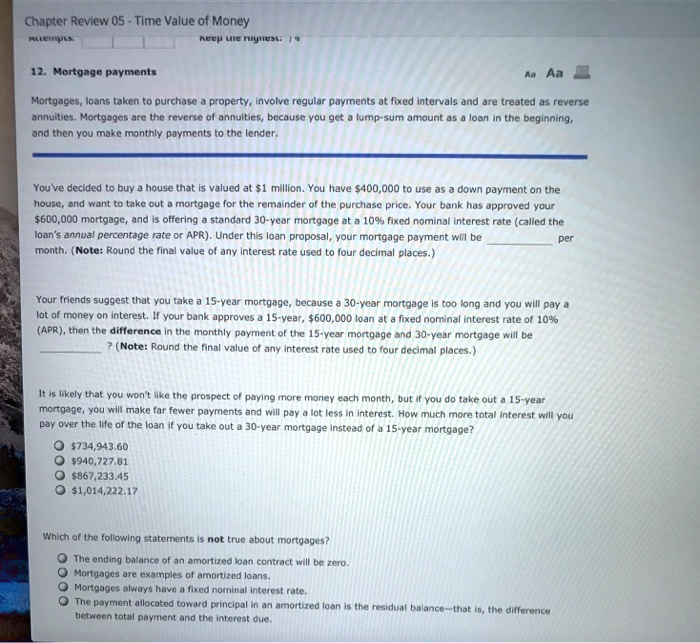
You've decided to buy a house that is valued at $1 million. You have $400,000 to use as a down payment on the house and want to take out a mortgage for the remainder of the purchase price. Your bank has approved your $600,000 mortgage and is offering a standard 30-year mortgage at a 10% fixed nominal interest rate (called the loan's annual percentage rate or APR). Under this loan proposal, your mortgage payment will be $5,305.55 per month. (Note: Round the final value of any interest rate used to four decimal places.)
Your friends suggest that you take a 15-year mortgage because a 30-year mortgage is too long, and you will pay a lot of money in interest. If your bank approves a 15-year, $600,000 loan at a fixed nominal interest rate of 10% APR, then the difference in the monthly payment of the 15-year mortgage and 30-year mortgage will be $1,014.22. (Note: Round the final value of any interest rate used to four decimal places.)
It is likely that you won't like the prospect of paying more money each month, but if you do take out a 15-year mortgage, you will pay over the life of the loan. If you take out a 30-year mortgage instead of a 15-year mortgage, the difference in the total amount paid over the life of the loan will be $734,943.60. $940,727.81. $867,233.45. $1,014,222.17.
Which of the following statements is not true about mortgages? O The ending balance of an amortized loan contract will be zero. O Mortgages are examples of amortized loans. O Mortgages always have a fixed nominal interest rate. The payment allocated toward principal in an amortized loan is the residual balance - that is, the difference between the total payment and the interest due.