Ace - AI Tutor
Ask Our Educators
Textbooks
My Library
Flashcards
Scribe - AI Notes
Notes & Exams
Download App
jennifer lane

jennifer l.

Divider

Questions asked

BEST MATCH

Longevity risk is an example of what type of risk Question 19 Answer a. market risk b. inflation risk c. credit risk d. underwriting risk

View Answer
divider
BEST MATCH

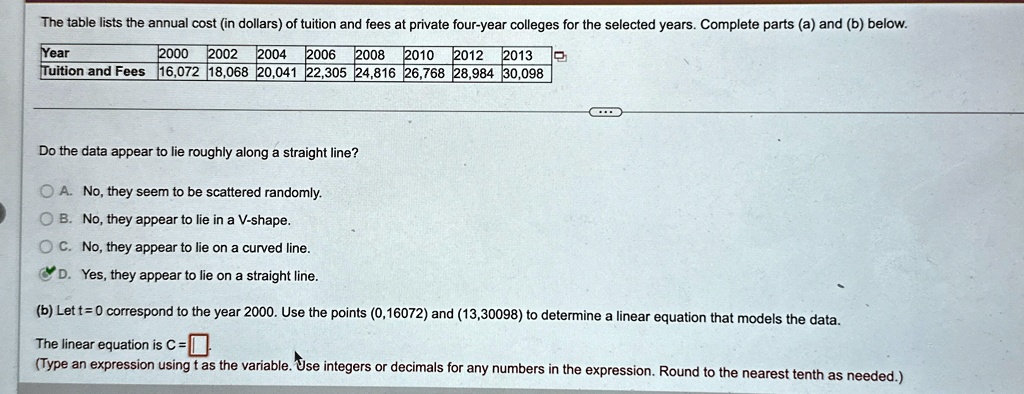
The table lists the annual cost (in dollars) of tuition and fees at private four-year colleges for the selected years. Complete parts (a) and (b) below. Year 2000 2002 2004 2006 2008 2010 2012 2013 Tuition and Fees 16,072 18,068 20,041 22,305 24,816 26,768 28,984 30,098 Do the data appear to lie roughly along a straight line? OA. No, they seem to be scattered randomly. B. No, they appear to lie in a V-shape. OC. No, they appear to lie on a curved line. D. Yes, they appear to lie on a straight line. (b) Let $t=0$ correspond to the year 2000. Use the points $(0,16072)$ and $(13,30098)$ to determine a linear equation that models the data. The linear equation is $C = \boxed{}$ (Type an expression using $t$ as the variable. Use integers or decimals for any numbers in the expression. Round to the nearest tenth as needed.)
View Answer
divider
BEST MATCH

For every NADH made in glycolysis, how many hydrogen ions are moved into the intermembrane space during the electron transport chain?

View Answer
divider
BEST MATCH

My Apps Dashboard | India Content new world reading scholar: https://irsc.blackboard.com/ultra/courses/_129303_1/cl/outline 105-20251-1V-M-007 College Algebra - INTERNET 08:00 AM IN|VC Content Module 4 - Polynomial anc apter 4 Practice Test Chapter 4 Practice Test Score: 23.14/40 - Answered: 27/40 Question 29 Find the domain of the given function. Enter the solution using set-builder and interval notation. \[ f(x)=\frac{x+6}{x^{2}-3 x-4} \] Using set-builder notation, the domain is: \[ \{x \mid x \neq \] \( \square \) Using interval notation, the domain is: \( \square \) Question Help: Video 1 Video 2 Submit All Parts

View Answer
divider
BEST MATCH

An ideal op-amp circuit is shown above. Assume that $v_1 = 4V$, $v_2 = 4V$, $R_1 = 5k\Omega$, $R_2 = 3k\Omega$, $R_3 = 2k\Omega$, $R_4 = 5k\Omega$. Please determine the output voltage $v_o$ in volts.

View Answer
divider
BEST MATCH

coca cola makes many tyles kf beverages j cm hint soft srj mw fome bas brown out another variation of a soft drink vanilla orange bt asst this orkut in a factory that already made.products coca cola is

View Answer
divider
BEST MATCH

3. (9p.) a) Use the Gaussian Elimination algorithm presented in lecture 04 to solve the linear system of algebraic equations described by the following augmented matrix. Circle the pivots. b) Write out all the solutions of the linear system of algebraic equations, specify which of them are dependent and free (independent) variables, denote them by $x_n$, i.e., $x_1, x_2, x_3,...$ $\begin{bmatrix} 1 & 1 & 1 & 2 & 0 & 1 \ 0 \ 2 & 1 & 3 & 0 & 0 & 2 \ 0 & 0 & 0 & -2 & 0 & 1 \ 3 & 2 & 4 & 4 & 0 & 2 \end{bmatrix}$

View Answer
divider
BEST MATCH

Sound levels in decibels (db) can be computed by D(x) = 10 log (10^{16}x). If the intensity x of a sound changes by a factor of \frac{1}{10}, by how much does the decibel level change?

View Answer
divider
BEST MATCH

Step Function Input The step function, AU(t), is defined as AU(t) = 0 t ? 0? AU(t) = A t ? 0? where A is the amplitude of the step function and U(t) is defined as the unit step function as depicted in Figure 3.5. Physically, this function describes a sudden change in the input signal from a constant value of one magnitude to a constant value of some other magnitude, such as a sudden change in 86 Chapter 3 Measurement System Behavior 2 U(t) 1 0 0 1 2 Time, t Figure 3.5 The unit step function, U(t). loading, displacement, or any physical variable. When we apply a step function input to a measurement system, we obtain information about how quickly a system will respond to a change in input signal. To illustrate this, let us apply a step function as an input to the general first-order system. Setting F(t) = AU(t) in Equation 3.4 gives $\tau\frac{dy}{dt} + y = KAU(t) = KF(t)$ with an arbitrary initial condition denoted by, y(0) = y?. Solving for t ? 0? yields y(t) = \frac{KA}{\tau} + (y? - \frac{KA}{\tau})e^{-t/\tau} Time response Steady response Transient response

View Answer
divider
BEST MATCH

In this problem, we numerically calculate a posterior distribution. Suppose the stimulus distribution ps(s) is Gaussian with mean 20 and standard deviation 4. The measurement distribution px|s(x|s) is Gaussian with standard deviation σ = 5. A Bayesian observer infers s from an observed measurement Xobs = 30. We are now going to calculate the posterior probability density using numerical methods. We expand on the previous problem by varying the stimulus distribution. Start with the code from the previous problem. Suppose the stimulus distribution ps(s) is uniform on the interval [−15,25] and 0 outside this interval. The measurement distribution px|s(x|s) is Gaussian with standard deviation σ = 5. A Bayesian observer infers s from an observed measurement xobs = 30. We are again going to calculate the posterior probability density numerically. a) What is the value of p(s) on the interval [−15,25]? b) Define a vector of hypothesized stimulus values s: (0, 0.2, 0.4, . . . , 40). c) Compute the likelihood function and the prior on this vector of s values. d) Multiply the likelihood and the prior pointwise. e) Divide this product by its sum over all s (normalization step). f) Convert this posterior probability mass function into a probability density function by dividing by the step size you used in your vector of s values (e.g., 0.2). g) Plot the likelihood, prior, and posterior in the same plot. h) Is the posterior Gaussian? i) Numerically calculate the mean of the posterior. j) Numerically calculate the variance of the posterior.

View Answer
divider