DRAW A DIAGRAM FOR EXAMPLE 1.8 Using unit vectors
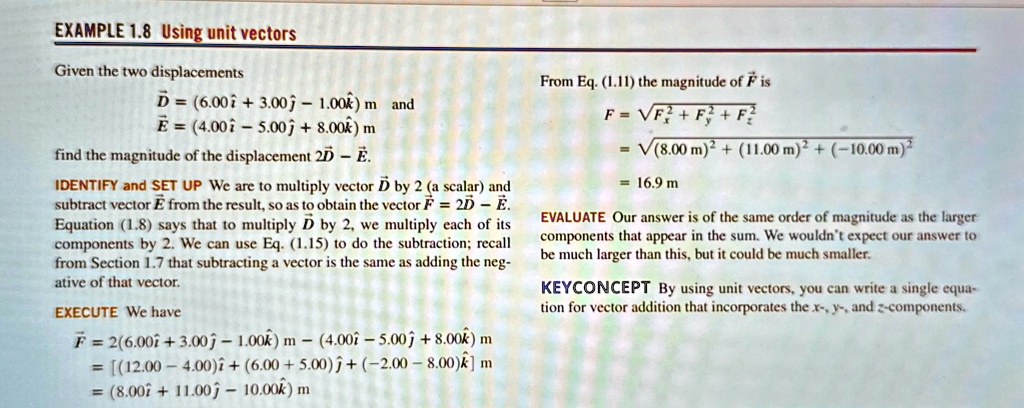
Given the two displacements
vec(D) = (6.00hat(i) + 3.00hat(j) - 1.00hat(k)) m and
vec(E) = (4.00hat(i) - 5.00hat(j) + 8.00hat(k)) m
find the magnitude of the displacement 2vec(D) - vec(E).
IDENTIFY and SET UP We are to multiply vector vec(D) by 2 (a scalar) and subtract vector vec(E) from the result, so as to obtain the vector vec(F) = 2vec(D) - vec(E). Equation (1.8) says that to multiply vec(D) by 2, we multiply each of its components by 2. We can use Eq. (1.15) to do the subtraction; recall from Section 1.7 that subtracting a vector is the same as adding the negative of that vector.
EXECUTE We have
vec(F) = 2(6.00hat(i) + 3.00hat(j) - 1.00hat(k)) m - (4.00hat(i) - 5.00hat(j) + 8.00hat(k)) m
= [(12.00 - 4.00)hat(i) + (6.00 + 5.00)hat(j) + (-2.00 - 8.00)hat(k)] m
= (8.00hat(i) + 11.00hat(j) - 10.00hat(k)) m
From Eq. (1.11) the magnitude of vec(F) is
F = sqrt(F_x^2 + F_y^2 + F_z^2)
= sqrt((8.00m)^2 + (11.00m)^2 + (-10.00m)^2)
= 16.9m
EVALUATE Our answer is of the same order of magnitude as the larger components that appear in the sum. We wouldn't expect our answer to be much larger than this, but it could be much smaller.
KEY CONCEPT By using unit vectors, you can write a single equation for vector addition that incorporates the x-component, y-component, and z-component.
EXAMPLE 1.8 Using unit vectors
Given the two displacements D = 6.00i + 3.00j - 1.00km and E = 4.00i - 5.00j + 8.00km find the magnitude of the displacement 20 - E. IDENTIFY and SET UP We are to multiply vector D by 2 (a scalar) and subtract vector E from the result, so as to obtain the vector F = 2D - E. Equation 1.8 says that to multiply D by 2, we multiply each of its components by 2. We can use Eq. 1.15 to do the subtraction; recall from Section 1.7 that subtracting a vector is the same as adding the negative of that vector.
From Eq. 1.11 the magnitude of F is
F = sqrt(8.00m + 11.00m - 10.00m)^2
= 16.9 m
EVALUATE Our answer is of the same order of magnitude as the larger components that appear in the sum. We wouldn't expect our answer to be much larger than this, but it could be much smaller.
KEY CONCEPT By using unit vectors, you can write a single equation for vector addition that incorporates the x-component, y-component, and z-component.
EXECUTE We have
F = 2(6.00i + 3.00j - 1.00km - (4.00i - 5.00j + 8.00km) = [12.00 - 4.00i + 6.00 + 5.00j - 2.00 - 8.00k]m = 8.00i + 11.00j - 10.00km