Ace - AI Tutor
Ask Our Educators
Textbooks
My Library
Flashcards
Scribe - AI Notes
Notes & Exams
Download App
jennifer lopez

jennifer l.

Divider

Questions asked

BEST MATCH

Reflect on the role of continuous learning and staying updated in the field of cybersecurity.

View Answer
divider
BEST MATCH

Predict the major organic product formed when the compound shown below undergoes a reaction with $CH_3ONa$ in $CH_3OH$. Interactive 3D display mode Part A $H_3C$ $H_3C$ $CH_3$ Draw the molecule on the canvas by choosing buttons from the Tools (for bonds), Atoms, and Advanced Template toolbars. The single bond is active by default.

View Answer
divider
BEST MATCH

Generally, what is the highest expense in restaurant and foodservice operations? a. Beverage cost b. Wage cost c. Linen cost d. Prime cost

View Answer
divider
BEST MATCH

1. When the doctor asks if the patient's vomiting is postprandial, she wants to know whether the vomiting occurs: before meals. after meals. before sleep. after sleep.

View Answer
divider
BEST MATCH

Explore the theoretical foundations of information theory, focusing on Shannon's theorem, entropy, and information channels. Discuss theoretical approaches to quantifying information, coding theory, and the limits of data compression and transmission over noisy channels.

View Answer
divider
BEST MATCH

_(___________ is an isomer of albuterol that is thought to have less side effects, specifically the tachycardia. However, studies showed that the decrease in tachycardia is modest at best. Xopenex Solu-medrol Ipratropium Epinephrine)

View Answer
divider
BEST MATCH

The Clayton Act of 1914 allowed a person who successfully sued a company for damages caused by an illegal arrangement to restrain trade to recover

View Answer
divider
BEST MATCH

A solution is prepared by dissolving 76.4g NaI in 545g of water. Determine the mole fraction of water for this solution. Molar mass of water is 18.02g/mol. Molar mass of NaI is 149.89g/mol.

View Answer
divider
BEST MATCH

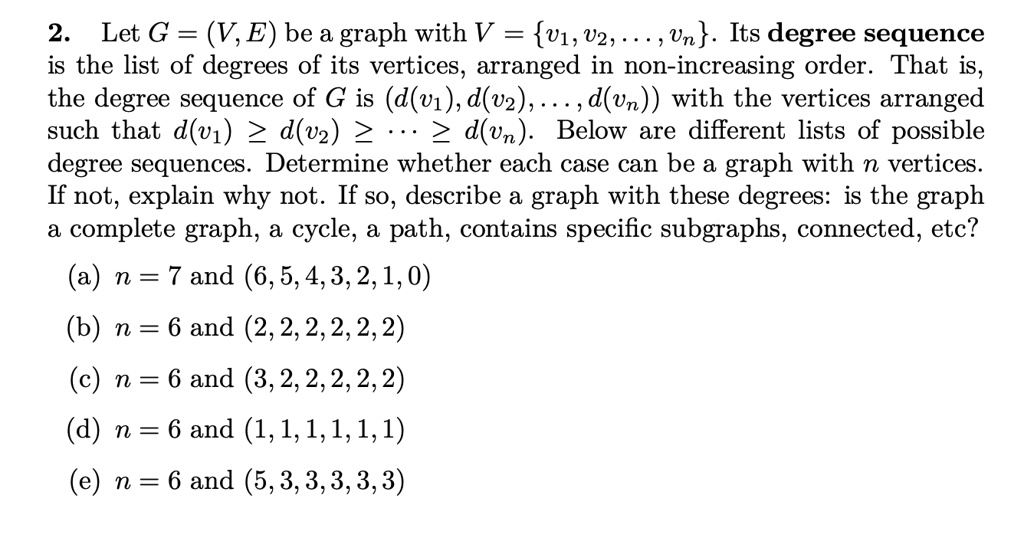
2. Let G = (V, E) be a graph with V = {$v_1, v_2, ..., v_n$}. Its degree sequence is the list of degrees of its vertices, arranged in non-increasing order. That is, the degree sequence of G is ($d(v_1), d(v_2), ..., d(v_n)$) with the vertices arranged such that $d(v_1) \ge d(v_2) \ge ... \ge d(v_n)$. Below are different lists of possible degree sequences. Determine whether each case can be a graph with n vertices. If not, explain why not. If so, describe a graph with these degrees: is the graph a complete graph, a cycle, a path, contains specific subgraphs, connected, etc? (a) n = 7 and (6, 5, 4, 3, 2, 1, 0) (b) n = 6 and (2, 2, 2, 2, 2, 2) (c) n = 6 and (3, 2, 2, 2, 2, 2) (d) n = 6 and (1, 1, 1, 1, 1, 1) (e) n = 6 and (5, 3, 3, 3, 3, 3)
View Answer
divider
BEST MATCH

The point is on the terminal side of an angle in standard position. Find the exact values of the six trigonometric functions of the angle.\ (20, 21)\ sin $\theta$ = \ cos $\theta$ = \ tan $\theta$ = \ csc $\theta$ = \ sec $\theta$ = \ cot $\theta$ =

View Answer
divider