1. Thermal runaway caused by temperature-dependent generation
L
L
$g_0 * (T/T_0)$
$T_0$
k
X
x = 0
$T_0$
Background: In overheating electrical circuits and batteries, it is
common to have temperature-dependent heat generation terms,
where higher temperatures lead to more heat generation. This
positive feedback can cause "thermal runaway," which can then lead
to catastrophic failures.
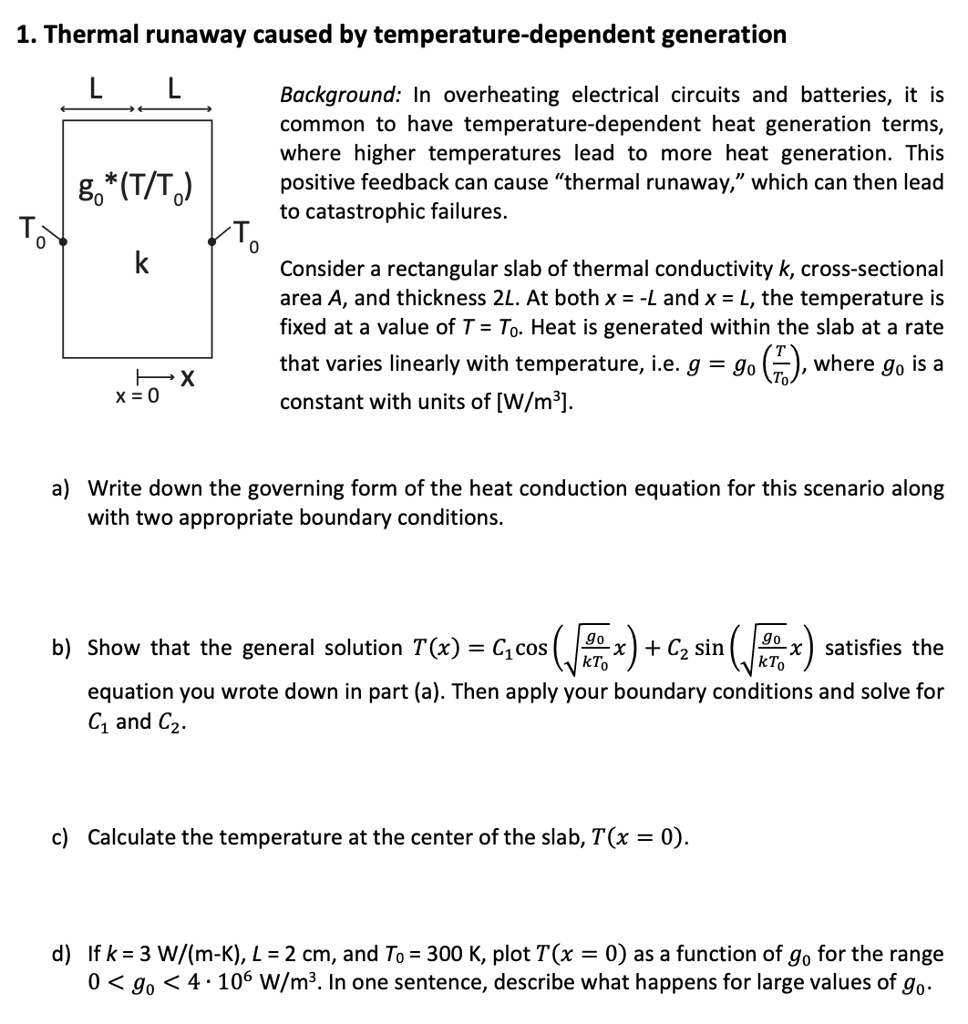
Consider a rectangular slab of thermal conductivity k, cross-sectional
area A, and thickness 2L. At both x = -L and x = L, the temperature is
fixed at a value of $T = T_0$. Heat is generated within the slab at a rate
that varies linearly with temperature, i.e. $g = g_0 (\frac{T}{T_0})$, where $g_0$ is a
constant with units of [W/m³].
a) Write down the governing form of the heat conduction equation for this scenario along
with two appropriate boundary conditions.
b) Show that the general solution $T(x) = C_1 cos(\sqrt{\frac{g_0}{kT_0}}x) + C_2 sin(\sqrt{\frac{g_0}{kT_0}}x)$ satisfies the
equation you wrote down in part (a). Then apply your boundary conditions and solve for
$C_1$ and $C_2$.
c) Calculate the temperature at the center of the slab, T(x = 0).
d) If k = 3 W/(m-K), L = 2 cm, and $T_0 = 300$ K, plot T(x = 0) as a function of $g_0$ for the range
$0 < g_0 < 4 \cdot 10^6$ W/m³. In one sentence, describe what happens for large values of $g_0$.