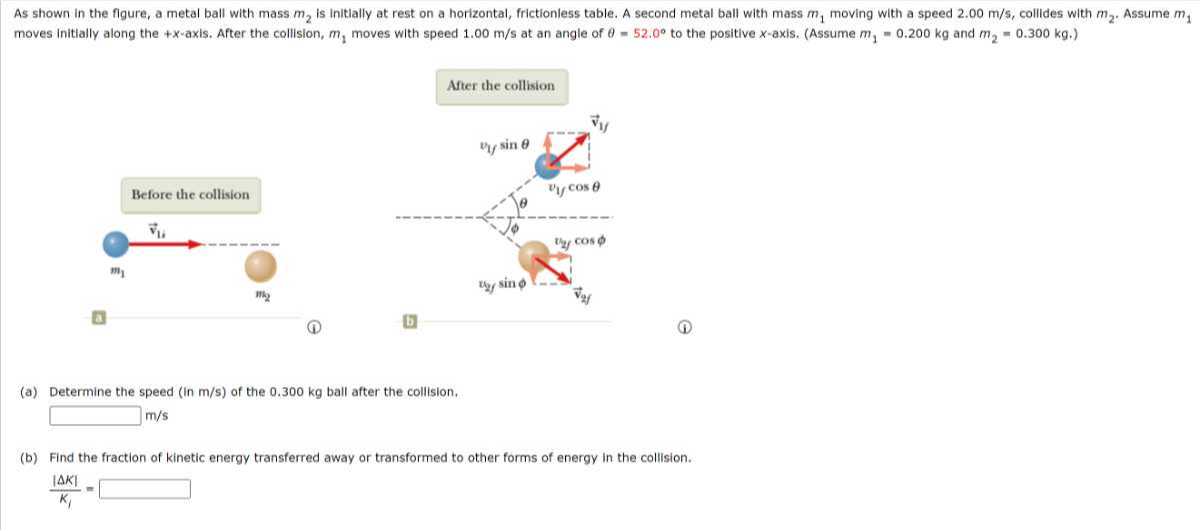
As shown in the figure, a metal ball with mass \( m_{2} \) is initially at rest on a horizontal, frictionless table. A second metal ball with mass \( m_{1} \) moving with a speed \( 2.00 \mathrm{~m} / \mathrm{s} \), collides with \( m_{2} \). Assume \( m_{1} \) moves initially along the \( +x \)-axis. After the collision, \( m_{1} \) moves with speed \( 1.00 \mathrm{~m} / \mathrm{s} \) at an angle of \( \theta=52.0^{\circ} \) to the positive \( x \)-axis. (Assume \( m_{1}=0.200 \mathrm{~kg} \) and \( m_{2}=0.300 \mathrm{~kg} \).)
After the collision
(1)
(a) Determine the speed ( \( \mathrm{in} \mathrm{m} / \mathrm{s} \) ) of the 0.300 kg ball after the collision,
\( \square \) \( \mathrm{m} / \mathrm{s} \)
(b) Find the fraction of kinetic energy transferred away or transformed to other forms of energy in the collision.
\( \square \)
\[
\frac{|\Delta K|}{K_{1}}=\square
\]