Ace - AI Tutor
Ask Our Educators
Textbooks
My Library
Flashcards
Scribe - AI Notes
Notes & Exams
Download App
jennifer nguyen

jennifer n.

Divider

Questions asked

BEST MATCH

1. One-phase transformer. 1000/100 V, 100 kVA, cosf=0.6, Works 80% of max power. Draw the equivalent model and mark all the parameters. Find the voltage regulation and efficiency when the angle is positive. Open circuit Short circuit U 100 V U 250 V I 6 A I 10 A P 400 W P 1800 W

View Answer
divider
BEST MATCH

Which scenario best demonstrates the concept of color-blind racism? Group of answer choices A New York City street vendor yells “ni hao” instead of “hello” at every Asian passerby, regardless of whether they are Chinese. A police officer tickets a Black driver for speeding but ignores a white driver committing the same offense. A Mexican American child is placed into an ESL class despite English being his first language. A white hiring manager claims she doesn’t care about race, but she never hires Black candidates who apply for jobs because they are “not a good fit” for the company.

View Answer
divider
BEST MATCH

8.4 Show that the total temperature ratios for the compressors of the two-spool turbojet engine [Eqs. (8.42) and (8.40)] can be written as \begin{align*} \tau_{cL} &= 1 + \frac{T_{14}/\theta_0}{(T_{14}/\theta_0)_R} (\tau_{cL} - 1)_R \\ \tau_{cH} &= 1 + \frac{T_{14}/\theta_0}{(T_{14}/\theta_0)_R} \frac{\tau_{cL}R}{\tau_{cL}} (\tau_{cH} - 1)_R \end{align*}

View Answer
divider
BEST MATCH

A consumer's optimum is found when O a. the marginal utility of the last dollar spent equals 0 for every good. b. the consumer saves part of their income. c. the consumer is achieving the maximum level of utility given market prices and their limited income. Od. prices of goods go down. A decrease in the price of a good causes Oa. the nominal wealth of a person to increase. Ob. purchasing power of a person's income to increase. Oc. the utility of the good to decrease. Od. the marginal utility of the good to decrease. A rational person will never consume a product when its O a. total utility is decreasing at an increasing rate. b. marginal utility is negative. c. total utility is increasing at a decreasing rate. Od. marginal utility is decreasing.

View Answer
divider
BEST MATCH

2. The graph of the function f is given in the figure: y 2 1 0 -1 -2 -3 -4 -5 -6 -2 -1 1 2 x f a. Determine the values of $f(-3)$, $f(-1)$, $f(1)$. b. Where does $f(x) = -2$? You must start a thread before you can read and reply to other threads

View Answer
divider
BEST MATCH

What are the relative prices (opportunity costs) of wine and cloth? a) wine costs 1/2 yard of cloth per bottle in England b) cloth costs 1/2 bottle of wine/yard in England c) cloth costs 4 man-hours/yard in Portugal d) cloth costs 2 bottles of wine/yard in Portugal e) wine costs 3 bottles of wine/yard in Portugal

View Answer
divider
BEST MATCH

A nightclub manager realizes that demand for drinks is more elastic among students, and is trying to determine the optimal pricing schedule. Specifically, he estimates the following average demand: Student: $q = 18 - 5p$ Adult: $q = 10 - 2p$ The two groups visit the nightclub in equal numbers on average. Assume that drinks cost the nightclub $2 each. (a) If the market cannot be segmented, what is the monopoly price under linear pricing? (b) If the nightclub can charge according to whether or not the customer is a student but is limited to charging the same per-drink price for each consumer of a group (i.e., linear pricing for each group), what price should be set for each group? (c) What is the welfare effect of the price discrimination in (b)? In other words, is the total welfare under the price discrimination in (b) higher or lower than that under linear pricing? (d) What is the welfare effect of the price discrimination in the format of (b) when each drink costs the nightclub $3? Hint 1: redo (a)(b)(c) with the marginal cost = 3. Hint 2: Will the manager decide to serve both groups under linear pricing? This question is related to the third claim about the welfare effect of third-degree price discrimination. Note: since we do not specify the unit of a drink, please ignore the integer issue (i.e., quantity does not need to be an integer)

View Answer
divider
BEST MATCH

Using superposition, determine the deflections at Points A and B of the beam shown in the figure. The material is 1040 carbon steel ($E = 29 \text{ Mpsi}$). (Table A-9 is attached on the back.) deflection y = y_{inter} + y_{center} 45^o 400 lbf 30^o 600 lbf 4 ft 2 ft 6 ft 3-in-dia. shaft

View Answer
divider
BEST MATCH

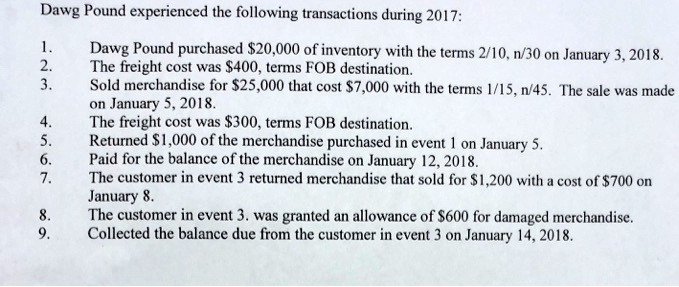
Dawg Pound experienced the following transactions during 2017: 1. Dawg Pound purchased $20,000 of inventory with the terms 2/10, n/30 on January 3, 2018. 2. The freight cost was $400, terms FOB destination. 3. Sold merchandise for $25,000 that cost $7,000 with the terms 1/15, n/45. The sale was made on January 5, 2018. 4. The freight cost was $300, terms FOB destination. 5. Returned $1,000 of the merchandise purchased in event 1 on January 5. 6. Paid for the balance of the merchandise on January 12, 2018. 7. The customer in event 3 returned merchandise that sold for $1,200 with a cost of $700 on January 8. 8. The customer in event 3. was granted an allowance of $600 for damaged merchandise. 9. Collected the balance due from the customer in event 3 on January 14, 2018.
View Answer
divider
BEST MATCH

43. Consider the following problem: (a) Suppose we have nine identical-looking coins numbered 1 through 9 and only one of the coins is heavier than the others. Suppose further that you have one balance scale and are allowed only two weighings. Develop a method for finding the heavier counterfeit coin given these constraints. (b) Suppose we now have an integer $n$ (that represents $n$ coins) and only one of the coins is heavier than the others. Suppose further that $n$ is a power of 3 and you are allowed $log_3 n$ weighings to determine the heavier coin. Write an algorithm that solves this problem. Determine the time complexity of your algorithm.

View Answer
divider