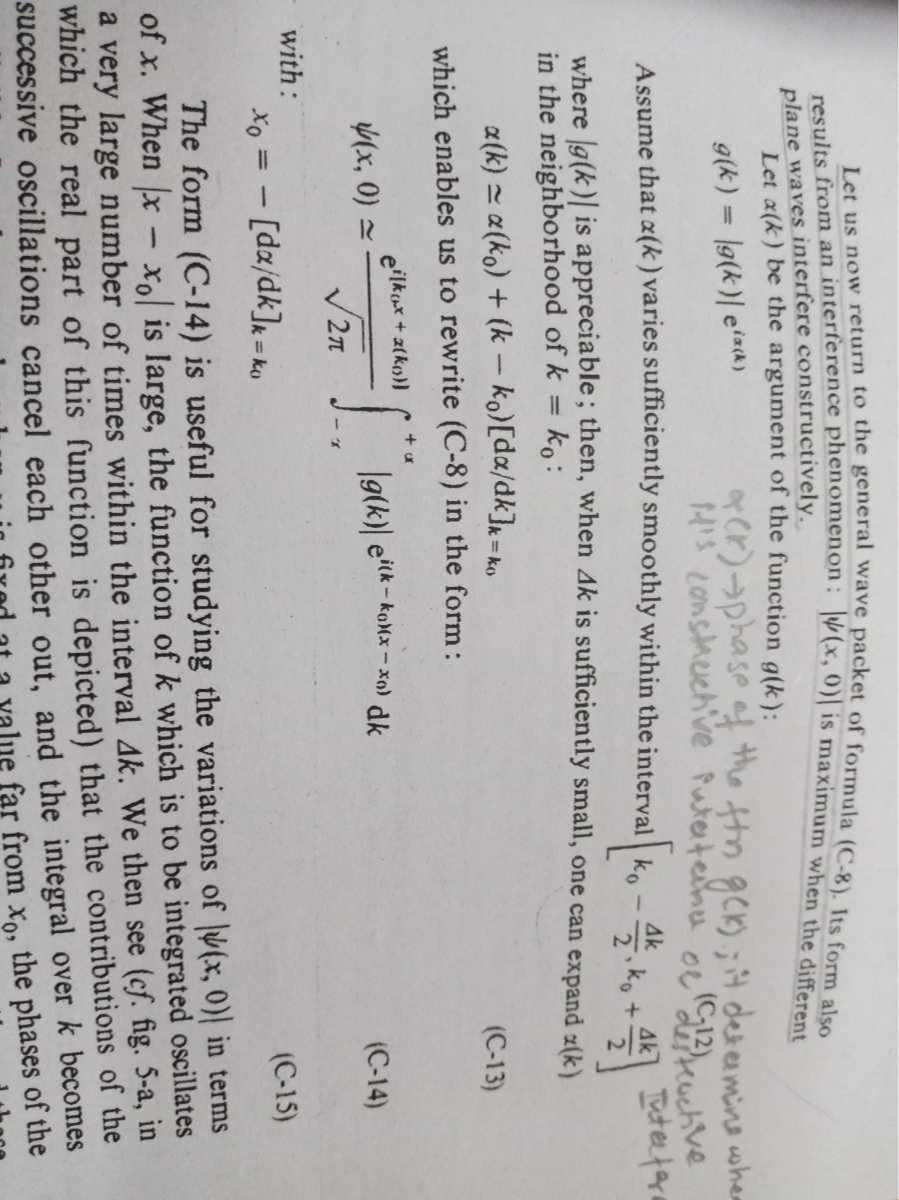
Let us now return to the general wave packet of formula (C-8). It form also results from an interference phenomenon: \( |\psi(x, 0)| \) is maximum when the different plane waves interfere constructively.
Let \( \alpha(k) \) be the argument of the function \( g(k) \) :
\( g(k)=|g(k)| \mathrm{e}^{i \alpha(k)} \quad \alpha(k) \rightarrow \) phase of the fton \( g(k) \); it detamins whe
t's construchive iutatanu oe (C) 212 ) teachve
Assume that \( \alpha(k) \) varies sufficiently smoothly within the interval \( \left[k_{0}-\frac{\Delta k}{2}, k_{0}+\frac{\Delta k}{2}\right] \) Ivtecfor
where \( |g(k)| \) is appreciable ; then, when \( \Delta k \) is sufficiently small, one can expand \( \alpha(k) \) in the neighborhood of \( k=k_{0} \) :
\[
\alpha(k) \simeq \alpha\left(k_{0}\right)+\left(k-k_{0}\right)[\mathrm{d} \alpha / \mathrm{d} k]_{k=k_{0}}
\]
which enables us to rewrite (C-8) in the form:
\[
\psi(x, 0) \simeq \frac{e^{i\left[k_{0} x+\alpha\left(k_{0}\right)\right)}}{\sqrt{2 \pi}} \int_{-x}^{+\alpha}|g(k)| \mathrm{e}^{i\left(k-k_{0}\right)\left(x-x_{0}\right)} d k
\]
with:
\[
x_{0}=-[\mathrm{d} \alpha / \mathrm{d} k]_{k=k_{0}}
\]
The form \( (\mathrm{C}-14) \) is useful for studying the variations of \( |\psi(x, 0)| \) in terms of \( x \). When \( \left|x-x_{0}\right| \) is large, the function of \( k \) which is to be integrated oscillates a very large number of times within the interval \( \Delta k \). We then see (cf. fig. \( 5- \) a, in which the real part of this function is depicted) that the contributions of the successive oscillations cancel each other out, and the integral over \( k \) becomes