Ace - AI Tutor
Ask Our Educators
Textbooks
My Library
Flashcards
Scribe - AI Notes
Notes & Exams
Download App
jennifer peterson

jennifer p.

Divider

Questions asked

BEST MATCH

If 44 coins can be exchanged for 6.17926.1792 dubloons, how many dubloons can be obtained for 99 coins? Question content area bottom Part 1 How many dubloons can be obtained for 99 coins? (Round to the nearest hundredth.)

View Answer
divider
BEST MATCH

What happens to muscle if crossbridges cannot detach? Muscle stays relaxed Muscle stays contracted This is normal and has no effect on muscle contraction Muscle cannot contract

View Answer
divider
BEST MATCH

The graph of $f(x)$ is shown (see figure). $f(x) = \frac{6x^2}{x^2 + 7}$ (a) Find the following limit. $L = \lim_{x \to \infty} f(x) = 6$ (b) Determine $x_1$ and $x_2$ in terms of $\epsilon$. $x_1 = -\sqrt{\frac{42}{\epsilon} - 7}$ $x_2 = \sqrt{\frac{42}{\epsilon} - 7}$ (c) Determine $M$, where $M > 0$, such that $|f(x) - L| < \epsilon$ for $x > M$. $M = \sqrt{\frac{42}{\epsilon} - 7}$ (d) Determine $N$, where $N < 0$, such that $|f(x) - L| < \epsilon$ for $x < N$. $N = -\sqrt{\frac{42}{\epsilon} - 7}$

View Answer
divider
BEST MATCH

(10%) Problem 1: A monatomic ideal gas initially fills a $V_o = 0.35 \text{ m}^3$ container at $P_o = 95 \text{ kPa}$. The gas undergoes an isobaric expansion to $V_1 = 1.4 \text{ m}^3$. Next it undergoes an isovolumetric cooling to its initial temperature $T_o$. Finally it undergoes an isothermal compression to its initial pressure and volume. ?10% Part (d) Write an expression for the change in internal energy, $\Delta U_1$ during the isobaric expansion (first process). 10% Part (e) Calculate the work done by the gas, $W_2$, in kilojoules, during the isovolumetric cooling (second process). $W_2 = 0.000$ ? Correct! ?10% Part (f) Calculate the heat absorbed $Q_2$, in kilojoules, during the isovolumetric cooling (second process). ?10% Part (g) Calculate the change in internal energy by the gas, $\Delta U_2$, in kilojoules, during the isovolumetric cooling (second process). ?10% Part (h) Calculate the work done by the gas, $W_3$, in kilojoules, during the isothermal compression (third process). ?10% Part (i) Calculate the change in internal energy, $\Delta U_3$, in kilojoules, during the isothermal compression (third process). ?10% Part (j) Calculate the heat absorbed $Q_3$, in kilojoules, during the isothermal compressions (third process).

View Answer
divider
BEST MATCH

Find the following matrix product, if possible. $\begin{pmatrix} 4 & 1 \ 0 & -5 \ 3 & 5 \end{pmatrix} \begin{pmatrix} 2 & -2 \ 3 & 1 \end{pmatrix} \begin{pmatrix} 3 \ 5 \end{pmatrix}$ Select the correct choice below and, if necessary, fill in the answer box to complete your choice. $\begin{pmatrix} 4 & 1 \ 0 & -5 \ 3 & 5 \end{pmatrix} \begin{pmatrix} 2 & -2 \ 3 & 1 \end{pmatrix} \begin{pmatrix} 3 \ 5 \end{pmatrix} = \square$ B. The product is not possible.

View Answer
divider
BEST MATCH

U(H, C) = 3H + 2C MU(H) = 3 MU(C) = 2

View Answer
divider
BEST MATCH

(40 points) Suppose that we want to compare the 2's complement integers in R1 and R2, and save the result in R0. If R1 is smaller than R2, R0=-1. If R1 equals to R2, R0=0. If R1 is larger than R2, R0=+1. Based on the following flowchart to solve this problem, write the corresponding program by using the LC-3 machine language. Remember to write the halt instruction at the end of your program. start R0-1 R3 NOT R2 R3R3+1 R3 R1 + R3 YES R3<0? ONT R3=0? YES ONI R0R0 + 1 R0+ R0+1 end

View Answer
divider
BEST MATCH

Asking for Help. A primary way in which individuals and collectivists differ is in the cultural messages they receive regarding asking for help. If you are more on the individualist side, and thus a person who finds it difficult to ask for the help of another, this exercise offers you a chance to break that habit. Select some activity for which you are especially unlikely to ask for help, and the next time you are in this situation, instead of trying to struggle through it by yourself, go ahead and ask another person for a hand. Here are some questions to ask yourself about a recent situation in which you could have asked for help: 1. Describe the circumstance, including all your thoughts and feelings. What did you imagine people would say if you asked for help? What would you have thought about yourself if you had asked for help? 2. Did you ask for help? If not, why not? If so, how did you overcome your rule of not asking for help? 3. How did the situation turn out when you did ask for help? What were the reactions of the person you asked for help? Did you get the needed help? If you did, how did you feel? Do you think you could ask for help in a future, similar situation?

View Answer
divider
BEST MATCH

1.1 (drawn from exercise 1.1 in your textbook) For each of the following situations, identify the population of interest, whether the population is existing or conceptual, the inferential objective, and how you might go about collecting a sample: b. A political scientist wants to determine whether a majority of adult residents of a state favor a unicameral legislature. c. A medical scientist wants to estimate the average length of time until the recurrence of a certain disease. d. An electrical engineer wants to determine whether the average length of life of transistors of a certain type is greater than 500 hours. e. A university researcher wants to estimate the proportion of U.S. citizens from \"Generation X\" who are interested in starting their own businesses.

View Answer
divider
BEST MATCH

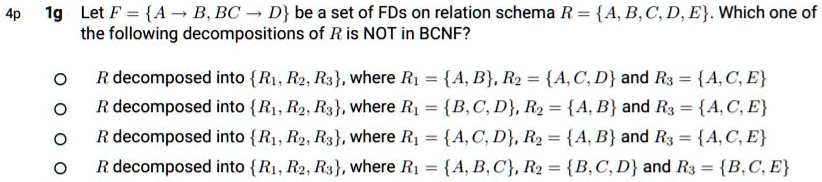
4p 1g Let F = {A \rightarrow B, BC \rightarrow D} be a set of FDs on relation schema R = {A, B, C, D, E}. Which one of the following decompositions of R is NOT in BCNF? R decomposed into \{R1, R2, R3\}, where R1 = {A, B}, R2 = {A, C, D} and R3 = {A, C, E} R decomposed into \{R1, R2, R3\}, where R1 = {B, C, D}, R2 = {A, B} and R3 = {A, C, E} R decomposed into \{R1, R2, R3\}, where R1 = {A, C, D}, R2 = {A, B} and R3 = {A, C, E} R decomposed into \{R1, R2, R3\}, where R1 = {A, B, C}, R2 = {B, C, D} and R3 = {B, C, E}
View Answer
divider