1) VECTOR CALCULUS PROOFS!
Use the methods of Griffiths section 1.2.6 and 1.3.6 to prove the following two claims:
a. $\oint_S \nabla T U \cdot d\vec{r} = \oint_V [T\nabla^2 U + (\nabla T) \cdot (\nabla U)]d^3\vec{r}$
(where "V" is a volume, "S" is the surface that bounds that volume, and T and U are arbitrary
scalar functions)
b. $\oint_S (T\nabla U - U\nabla T) \cdot d\vec{r} = \oint_V (T\nabla^2 U - U\nabla^2 T)d^3\vec{r}$+
This is called "Green's Theorem", and we'll use it in Ch. 3 to prove a much more practical result,
the "uniqueness theorem". Formal mathematical manipulation may not seem like it directly
relates to physics but I promise you it does. These sorts of relationships say things about vector
and scalar fields that directly relate to real physical properties.
2) ANGLE BETWEEN SUSPENDED CHARGES
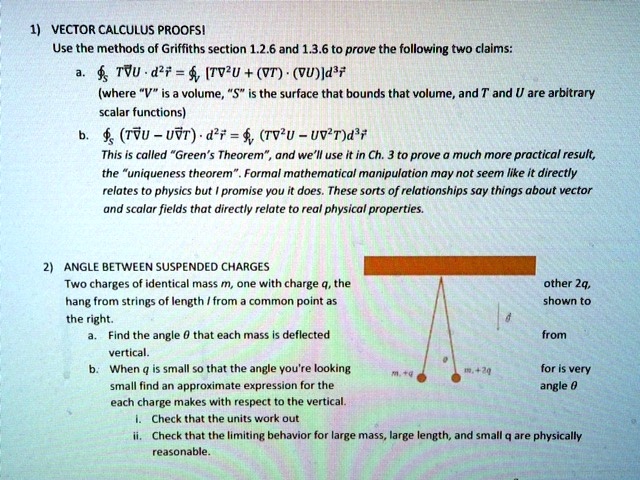
Two charges of identical mass m, one with charge q, the
hang from strings of length l from a common point as
the right.
a. Find the angle $\theta$ that each mass is deflected
vertical.
b. When q is small so that the angle you're looking
small find an approximate expression for the
each charge makes with respect to the vertical.
\hspace{1cm}i. Check that the units work out
other 2q,
shown to
from
for is very
angle $\theta$
\hspace{1cm}ii. Check that the limiting behavior for large mass, large length, and small q are physically
reasonable.