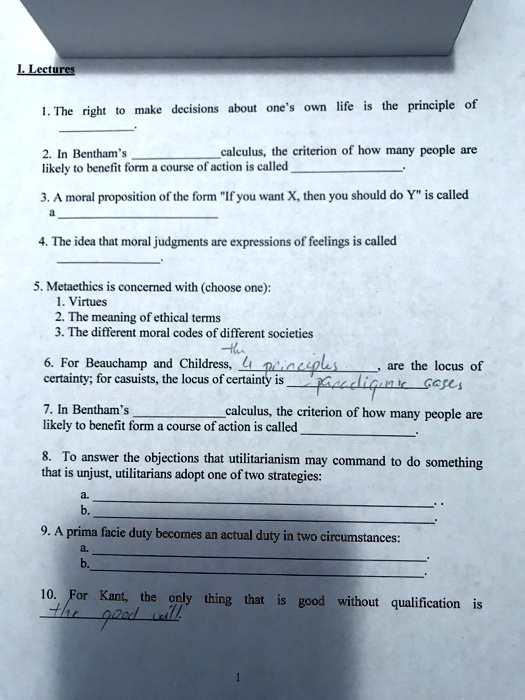
1. The right to make decisions about one's own life is the principle of autonomy.
2. In Bentham's calculus, the criterion of how many people are likely to benefit from a course of action is called utility.
3. A moral proposition of the form "If you want X, then you should do Y" is called a hypothetical imperative.
4. The idea that moral judgments are expressions of feelings is called emotivism.
5. Metaethics is concerned with the meaning of ethical terms.
6. For Beauchamp and Childress, principles are the locus of certainty; for casuists, the locus of certainty is cases.
7. In Bentham's calculus, the criterion of how many people are likely to benefit from a course of action is called utility.
8. To answer the objections that utilitarianism may command to do something that is unjust, utilitarians adopt one of two strategies: a.
9. A prima facie duty becomes an actual duty in two circumstances: c.
10. For Kant, the only thing that is good without qualification is goodwill.