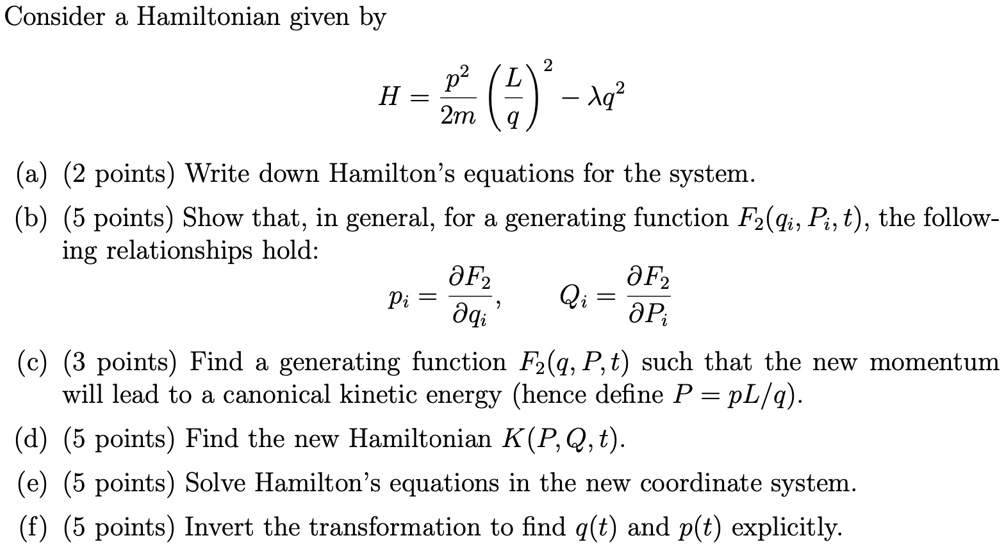
Consider a Hamiltonian given by
\begin{equation*}
H = \frac{p^2}{2m} \left(\frac{L}{q}\right)^2 - \lambda q^2
\end{equation*}
(a) (2 points) Write down Hamilton's equations for the system.
(b) (5 points) Show that, in general, for a generating function $F_2(q_i, P_i, t)$, the follow-
ing relationships hold:
\begin{align*}
p_i &= \frac{\partial F_2}{\partial q_i}, \\
Q_i &= \frac{\partial F_2}{\partial P_i}
\end{align*}
(c) (3 points) Find a generating function $F_2(q, P, t)$ such that the new momentum
will lead to a canonical kinetic energy (hence define $P = pL/q$).
(d) (5 points) Find the new Hamiltonian $K(P, Q, t)$.
(e) (5 points) Solve Hamilton's equations in the new coordinate system.
(f) (5 points) Invert the transformation to find $q(t)$ and $p(t)$ explicitly.