Gram-positive Cocci
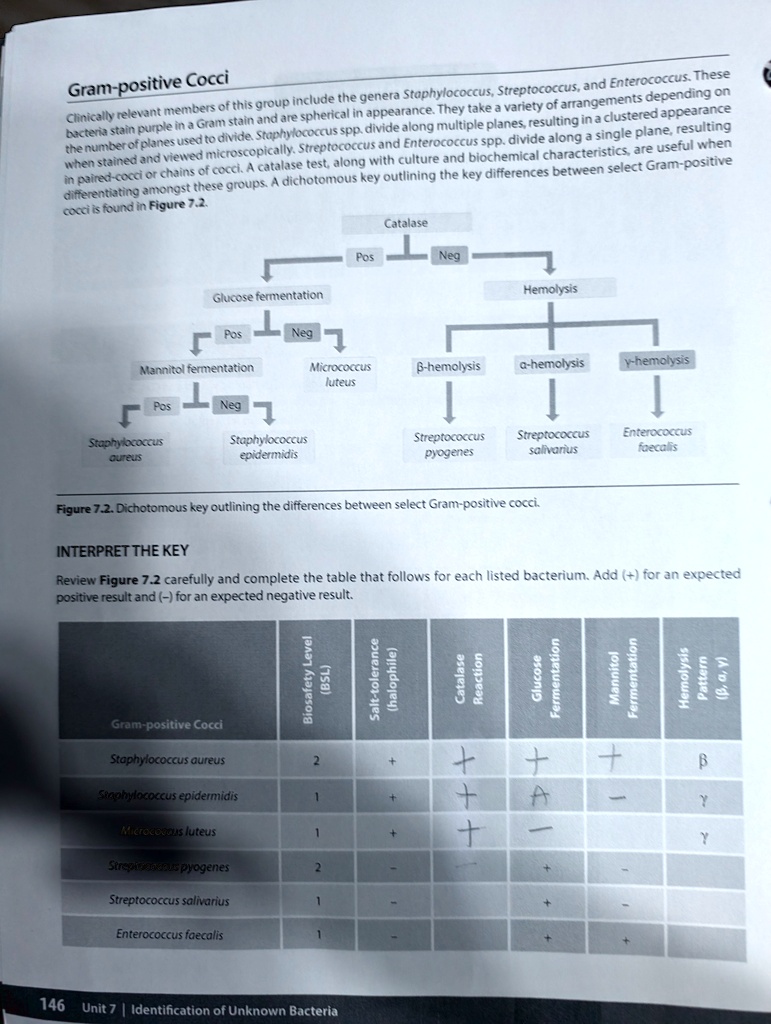
Clinically relevant members of this group include the genera Staphylococcus, Streptococcus, and Enterococcus. These bacteria stain purple in a Gram stain and are spherical in appearance. They take various shapes, resulting in arrangements depending on the number of planes used to divide. Staphylococcus spp. divide along multiple planes, resulting in a clustered appearance when stained and viewed microscopically. Streptococcus and Enterococcus have different biochemical characteristics, dividing along a single plane, resulting in paired cocci or chains of cocci. A catalase test, along with culture, are key differences between select Gram-positive cocci, differentiating amongst these groups. A dichotomous key outlining the differences between select Gram-positive cocci is found in Figure 7.2.
Figure 7.2. Dichotomous key outlining the differences between select Gram-positive cocci.
INTERPRET THE KEY
Review Figure 7.2 carefully and complete the table that follows for each listed bacterium. Add (+) for an expected positive result and (-) for an expected negative result.
Gram-positive Cocci
Cocci is found in Figure 7.2
Catalase
Pos
Neg
Glucose fermentation
Hemolysis
Micrococcus luteus
- hemolysis
Streptococcus pyogenes
α-hemolysis
γ-hemolysis
Streptococcus salivarius
Enterococcus faecalis
Mannitol fermentation
Staphylococcus epidermidis
Staphylococcus aureus
Figure 7.2. Dichotomous key outlining the differences between select Gram-positive cocci.
INTERPRET THE KEY Review Figure 7.2 carefully and complete the table that follows for each listed bacterium. Add (+) for an expected positive result and (-) for an expected negative result.
Salt-tolerance (halophile) Catalase Reaction Glucose Fermentation Fermentation Hemolysis (A'n'g) 2 + + + + 1 + + α - 1 + + 2
Gram-positive Cocci
Staphylococcus aureus
Staphylococcus epidermidis
Micrococcus luteus
Streptococcus pyogenes
Streptococcus salivarius
Enterococcus faecalis
146 Unit 7I Identification of Unknown Bacteria